People engage in political activity everyday. The body is a rich site of activity that as Susan Bordo argues, is an "unbearable weight" to the intelligence, power, and ideal state of the mind. People are constantly in turmoil between what the mind thinks is right and what the body wants. The separation of the material and the spiritual is the basis for many religious rituals and has plagued theorists like Descartes, Durkheim, and others for many years.
One arena where this emerges is the political action of eating. One's choice of food is immensely important in crafting one's identity, and happens, for most people, multiple times a day. It is an act of material consumption that reaffirms an identity. For some, choosing to eat or not to eat at Chick-Fil-A became a stance on gay rights. As a vegetarian, my abstaining from meat is a choice for environmental protection and animal rights. A choice for a high-class, Michelin-starred restaurant over a food truck or trip to the grocery store may communicate affluence, leisure, and class. From farmer's markets, health campaigns, and food norms, the rhetoric of food is a site of power and control.
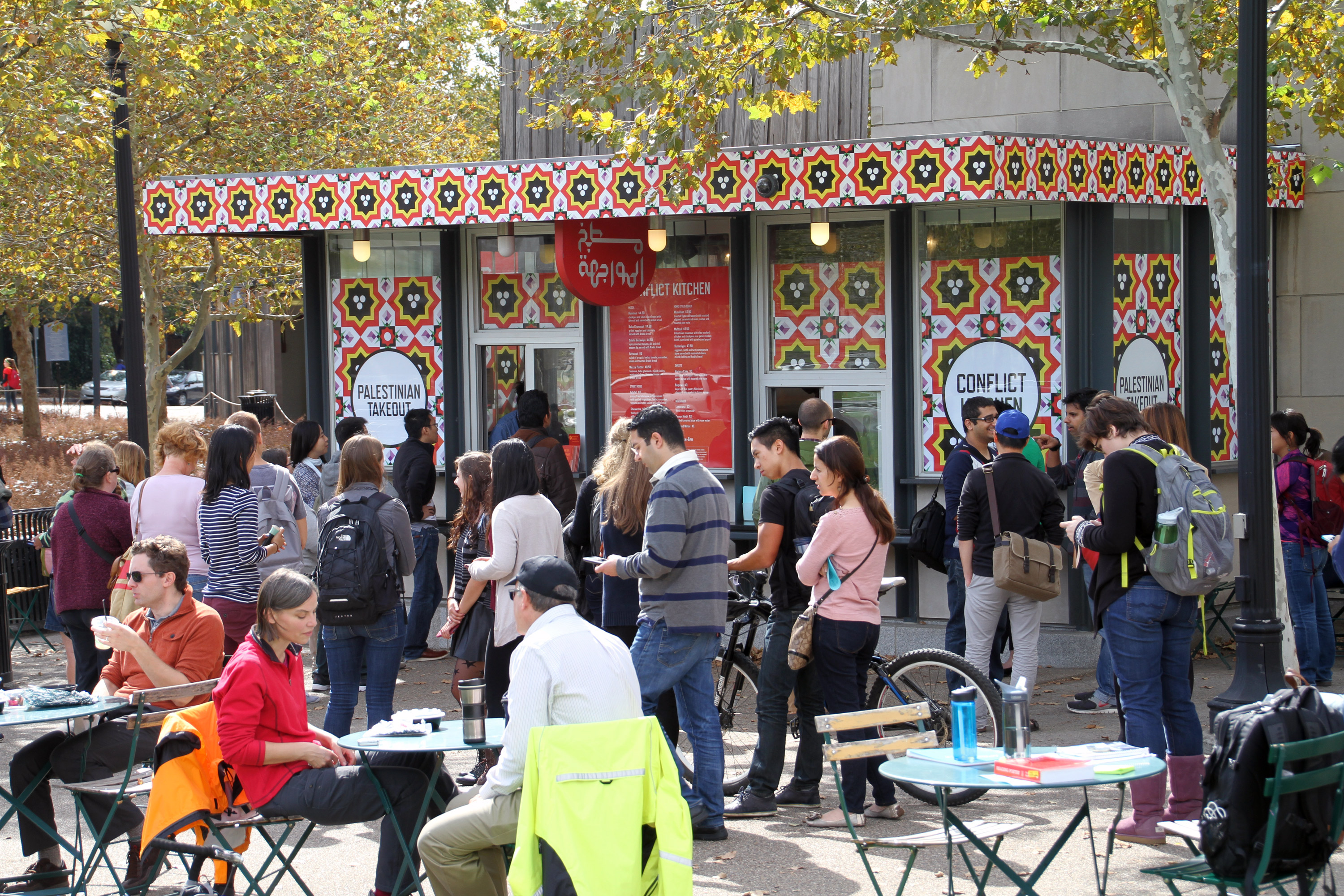
In believing that the material can argue and that food is itself symbolic and meaningful, it is easy to find examples of food's importance in everyday life. I was confronted with a particularly meaningful example when I visited Pittsburgh, PA. There is a restaurant called "Conflict Kitchen." The cuisine rotates but always features "cuisine from countries with which the United States is in conflict." The food experience is also complemented by activities, speakers, and events that draw attention to particular conflicts. Currently, the Conflict Kitchen prepares Palestinian food to bring awareness to the conflict in Palestine, the Gaza Strip, and Israel. Considering that America has only experienced 21 years of peace since it was created in the wake of the American Revolution, Conflict Kitchen will most likely have many food options for a long time.
Current Palestinian theme. Photo credit to Conflict Kitchen
Their mission statement is as follows: "Conflict Kitchen uses the social relations of food and economic exchange to engage the general public in discussions about countries, cultures, and people that they might know little about outside of the polarizing rhetoric of governmental politics and the narrow lens of media headlines." Through the medium of food, Conflict Kitchen reminds us of the cultural and personal aspects of conflict and war. It is easy to be distracted by the sweeping political statements and larger picture of global diplomacy. But it is hard to argue with the significance of cultural imports, cross-country interactions, and the new global village when eating. A simple, daily activity becomes a statement in support of cultural unity and against international conflict.
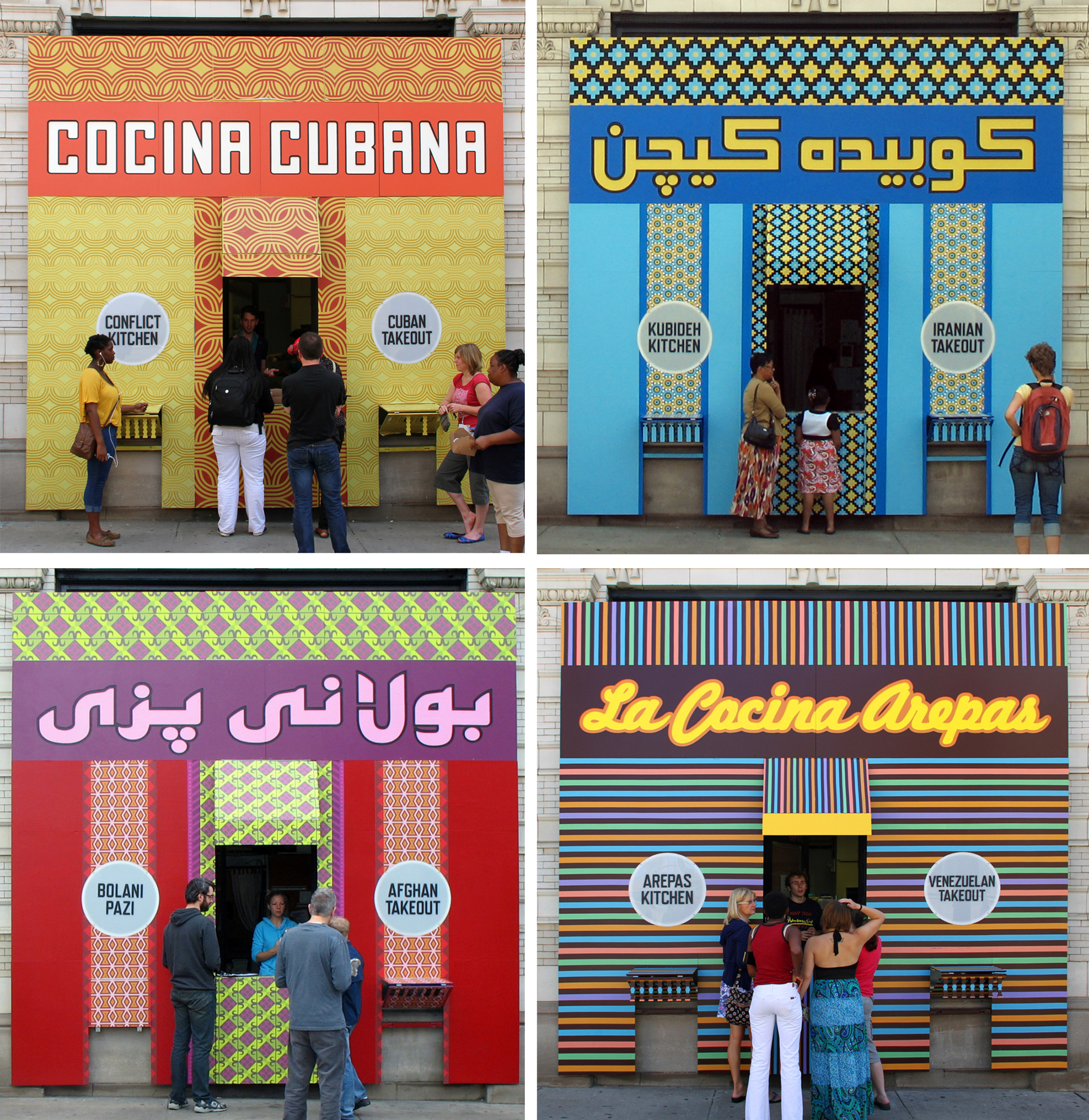
Different themes over time. Photo credit to Conflict Kitchen
Conflict Kitchen has also served food from Iran, Afghanistan, Venezuela, and North Korea. The variety of food available in this one kitchen highlights the relative lack of diversity in Pittsburgh's culinary offerings. Conflict Kitchen notes that it was the first and only of these ethnic restaurants "the city has ever seen." The lack of ethnic neighborhoods, outside of the European populations that are prominent in the city, makes the location of Conflict Kitchen particularly memorable. I am working on a paper that explores the ideas of experiential and rhetorical landscapes: the location of artifacts is commensurate with the site itself. Placing the Conflict Kitchen in Los Angeles may not have the same visceral effect as in the relatively homogeneous Pittsburgh.
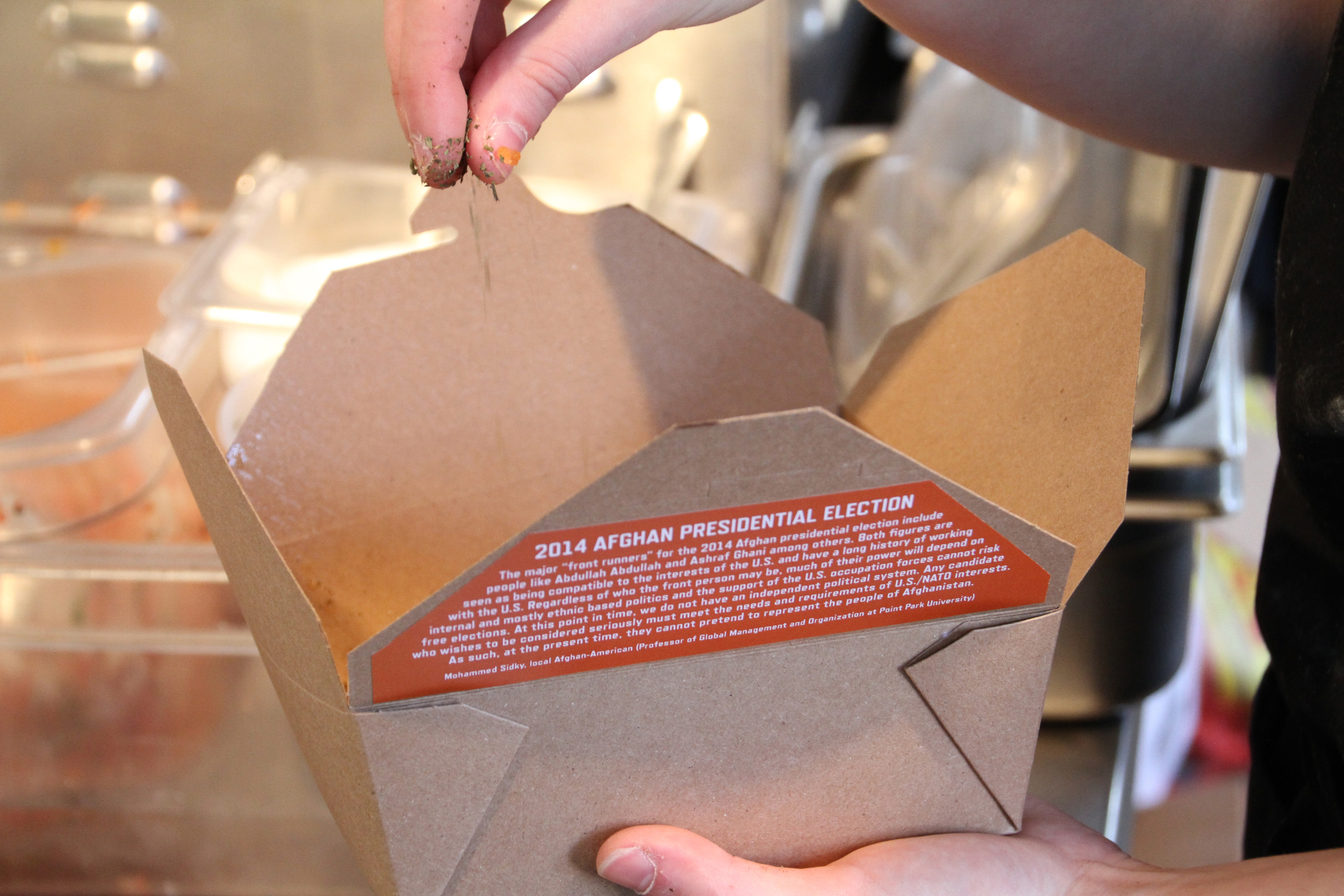
Information on take-out box. Photo credit to Conflict Kitchen
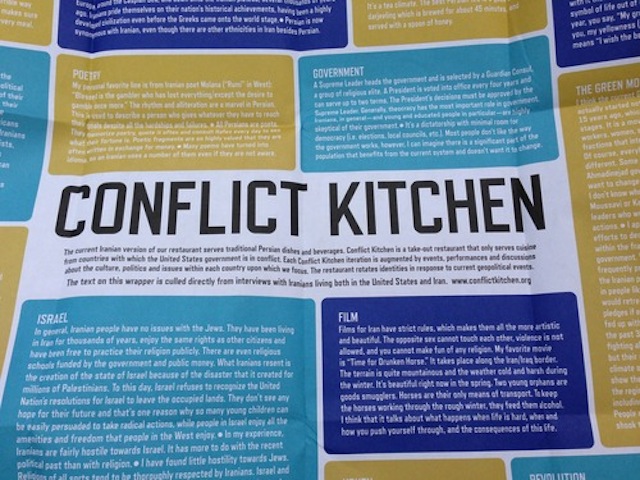
Food wrapped in information sheet. Retrieved from this site
In addition to bringing food and culture to the attention of the city, Conflict Kitchen also wraps its food in large, informational sheets about the country. From government, politics, art, poetry, entertainment, and other areas, the unfolded food wrappers educate the food consumers about the country of origin. Conflict Kitchen thus offers food for thought and symbolic consumption as well as physical, material nourishment. For Conflict Kitchen, eating is a mindful act that calls us to consider the political and social implications of our daily consumption habits. There is an increasing trend in communication theory to explore how consumption, branding, and purchasing power has become a form of identity-management. What one buys, owns, and consumes is indicative of one's identity. I hope that more companies do adopt more conscious effort toward the impacts that their services and products have. Although there are concerns about the potential implications of charity-focused groups, I think overall there are steps to be made in shifting capitalist thought towards producing a more aware, global citizenry.
Catcalling has been appearing frequently in article I've been reading, on social media, and in conversations with friends. I have already discussed more generally the problems that females face specifically on college campuses, but catcalling is a form of aggression that plagues all women. I use the term aggression purposefully and meaningfully as these catcalls are verbal, sexual assaults on females. These are, in many ways, hate crimes in that they are addressed and targeted towards a particular gender. I argue that these are violent, aggressive verbal attacks on females and are not addressed in order to be compliments or flattery. Any woman of all shapes and sizes in clothing from SoCal casual to Boston coats (I have seriously been catcalled walking down Boylston in my HUGE winter jacket) are catcalled. Like rape, catcalling is not about "flattering" or "complimenting" someone; it is about power, laying claim, objectifying, and reifying an order where men can and are allowed to "be men." The clip below is from a Fox News show where four clueless women and one man discuss how flattering and welcoming catcalling is.
The hosts argue "let men be men." This statement characterizes men as overly sexual, aggressive, and blameless for their actions. This attitude let's men off for perpetrating abusive, violent action towards women. The blame is shifted to the victims for not "taking a joke," their choice of outfit that incites a catcall, or walking in a certain area. Victim blaming is never something that should be encouraged or tolerated in society. Just like bullying or assault on college campuses, it is always the fault of the perpetrator, the person committing the crime and assault. It is never the fault of the victim. In the famous words of the recently passed Robin Williams in Good Will Hunting, victims must always remember, "it's not your fault." The hosts of the show should be ashamed of themselves for laughing and tolerating the inane slow clap of their male counterpart. The female presence is not a show or performance for the adoration or approval of males.
I have been catcalled many times and the first thing that I have thought was not, "oh how nice," or "how flattering!" Instead, it immediately places me in a subject position where my presence is only meaningful in that is a display and object for the male gaze. In one instance, I had a man follow me off a bus in Los Angeles and onto the Metro, yelling at me and attempting to accompany me to my destination. I will probably never forget the fear I felt when I realized he was behind me as I stepped off the bus. My relief in getting out of the situation became sheer panic. He ran up next to me and said, "I'm not trying to scare you sweetie, I just want to marry you." Another time, I was grabbed from behind by a young male on a skateboard on the very street where I live. This catcall, which I tried to ignore, ended in physical assault and made me feel like an object to be squeezed, held, and owned by others. When I step on the street, I have no control over the actions of others, what they may call me, how they may judge me, but I will say that it is more rare than not to have an assault-free day. Louis Althusser noted that when a police officer yells, "Hey you!" at someone, they immediately construct a subject position for them to inhabit. This interpellation is done from a position of power that constructs for the other person an identity that they have no part in constructing. Any reaction is to that assignment position within what Althusser called an "ideological state apparatus" that reifies hierarchy.
Buzzfeed attempted to create a humorous interpretation of catcalling. The video shows "What men are really saying when catcalling." This video is important because it addresses the counter-argument that many people use to defend catcalling: that it is a legitimate way to approach a female. If someone is interested, why not simply call out to them and engage them in conversation? Well, as the video shows and as I fully agree, catcalling is not an invitation. There is no desired or appropriate response. The male simply wishes to undermine the female, assert power, and inflate their own egos. As one of the males in the video states, "I noticed you're confident, so I'm cutting you down to feel powerful." Another notes that he's not sure why he's calling because he wouldn't know what to do if the female responded. When I have tried to respond to catcallers, I am either called a bitch, frigid, or am assumed to already have a boyfriend. Because already being owned by a male is the only reason to call off an approach.
Playboy also recently released a chart that describes when it is appropriate to catcall a female. Though my initial reaction was, "why do you need a flowchart to define the word 'never'?" this chart is important because it incorporates the participation of the female. The only way for catcalling to be appropriate, via this chart, is with the consent and agreement of the female party. This approach considers females active agents instead of simply passive objects to be called upon.
Catcalling engages issues of hierarchy and ideology. In what situations do females catcall men? In what situations do females have the power to objectify and undermine men? Simply put, they never do. The structure of hierarchy implies that the minority or discriminated group never has the agency or power to discriminate themselves. Any action is performed within that hierarchy. My response to a catcaller is always framed with the male in the right and myself in the wrong. Althusser's police office constructs the situation and appropriates the actions of the passerby without a need for reaction. Because of their respective positions within the system, the act of addressing and calling upon someone places them in the position of vulnerability, object, and minority. Catcalling reifies a structure that says that men are always in a position of power over women.
Retrieved from this site. Stats are specific to Hollaback Boston.
A few organizations, such as Hollaback , are trying to end street harassment. Hollaback focuses on sharing the stories of females who have been harassed in a triple-pronged attempt to promote awareness of how frequent and widespread the issue is, to provide validation for females who have been verbally harassed, and to promote healing through collective storytelling. I hope that initiatives like this can help to make real and present the plight of harassment that females experience every day. We as a society need to move away from victim blaming, listen to the stories of those shamed and objectified, and acknowledge the societal guilt that we all share by allowing this culture to exist. Though I am not knowledeable enough to comment in more depth, I do want to use this post as an opportunity to amplify how these issues often specifically and disproportionately affect women of color and the transgender community.
I've already addressed my opinions on the societal shun of horror films. I think that horror films are much more inventive and experimental than traditional genre films and I wish more of my peers appreciated their subtle depth and creativity. This post is specifically about the second installment of The Purge, which I highly encourage everyone watch. Unlike the original, The Purge: Anarchy is a slick thriller with a moral message about class, race, and oppression. I will briefly discuss the horror aesthetics in this film (and its original) before discussing this interconnected themes of hierarchy and exploitation. The cultural scholar and common person alike would greatly benefit from exploring these themes on the silver screen (even with a bit of gore). It may not need saying, but this post will contain spoilers of both films.
The Purger: Anarchy Trailer. Retrieved from YouTube.
The first film was typical of its genre. There were cliche pop-out-from-behind-a-corner fake scares, misdirection, and a dearth of larger meaning than the human urge to kill. The film centered around the near future where a government has issued a 24-hour lift of all laws allowing society to "purge" through murder, robbery, etc. This results in a lower crime rate through the rest of the year and a boon in sales of home defense systems. The first film followed a family that had a break-in in their home after the young son tried to save a man being hunted in their neighborhood. This film was simply okay, an interesting idea poorly executed and mostly abandoned for the cheap and easy scares. I almost didn't go see the second film because of my disappointment in the first. I'm very glad that I didn't miss it.
The Purge: Anarchy focuses on the streets that are ravaged by roaming bands of vigilantes and the mysterious presence of military and government forces patrolling the streets. A Malcolm X type figure (Carmelo) becomes a prominent character who preaches that the purge is a government tactic to eradicate the poor (and subsequently, minorities) in order to keep the crime rate down during the year. We find out during the film that the government is targeting low income neighborhoods, kidnapping people, and performing genocides of the lower classes. One black woman and her daughter are saved from this government kidnapping by a (white) purger looking for revenge on the man who killed his son in a car accident.
Two scenes stand out for me as particularly shocking and expressive. The father of the woman saved from government forces disappears early in the film. The daughter and granddaughter find out that he has sold himself to a rich white family for $100,000 to allow them to purge in the safety of their home. The white family has literally bought a poor, black body as if it were property, to ruthlessly destroy and exploit it without exposing themselves to the risks of the purge. There is a poignant frame where the nuclear family is standing around the father wielding weapons in their pristine suits and plastic-wrapped living room of expensive art. Their massacre of this man will be their new art, their secret expression of white privilege that protects their valuables, status, and domination over the lower class.
Auctioneer before the hunt. Retrieved from this site.
The second powerful scene is shown briefly at the end of the trailer where a woman in a blue dress announces before a seated group of people in fancy dress that they have collected the last purge of the evening. The main characters are released into a pitch black maze where the highest bidders enter with night vision goggles and weapons to hunt them down. There are obvious echoes here about the purchasing of bodies as in the previous scene, but it also echoes themes from Richard Connell's "The Most Dangerous Game." This short story is about a stranded man looking for protection who ends up being hunted down for sport like an animal in a rich man's safari game. Humans being the most cunning (and thus perhaps most satisfying to kill) animal provides an elevated type of sport than the traditional hunt. Indeed, the highest bidders in The Purge: Anarchy wear traditional British fox hunting uniforms as if they were out in a normal hunting activity and not viciously murdering other people. In a quite satisfying ending, I will simply mention that the group manages to get a hold of one of the night vision goggles and weapons, making the hunt more of a fair fight.
Both of these scenes highlight for me the interrelationship between class and race and the exploitative powers of a system that only reifies the lasting order and undervalues the lives of poor and minority bodies. In this film, both the rich and the government specifically target and kill blacks, the homeless, deviants, and youth in an attempt to eradicate and "purge" the society of perceived evils. This movie asks us all to reflect on who is in power, what oppressive acts are they committing, and who does society really serve. Both the murderers and the white families who can afford to lock up and hide are complicit in the exploitation and eradication of people deemed unworthy of life. Just as a police officer in Ferguson made a decision of life and death for Michael Brown, The Purge: Anarchy asks us to consider who is in control and what those consequences are. Who gets to define who is worthy of life? Who gets to define how punishment is laid out? Who is in control of our streets, our livelihoods, our identities as targets or as civilians?
Carmelo, leader of the anti-purge movement. Retrieved from this site.
Carmelo is trying to start a revolt against this system. He targets the rich, white, and off-limits bodies to upend the genocide of the poor and the minorities. His tactics are in part successful, at least in saving the lives of the main characters, but his ultimate goal is left unfulfilled. Will it take violent revolution to change the system? Can violence itself do anything but reify the use of violence as a peace-keeping tactic? If anything can be learned in the current state of Ferguson, it is that the tensions between authority, race, and class run deep, and define for entire groups of people their ability to claim a place on this earth free from fear and death. That is unacceptable and violates the very basics of human rights. The Purge: Anarchy brings these themes to life in an exaggerated thriller that asks us to ponder our own situation: how far off are we from this being our reality?