There has been an influx of attention on the phenomenon of "the selfie." I know that I am perhaps a little late to this discussion, partly because it is far outside my typical realm of interest. A small epiphany regarding them, however, has prompted me to address what I think is an overlooked but important aspect of the selfie: the Freudian divide between self-love and object-love. The selfie is the perfect integration of our love for technology and our love for ourselves. To illustrate this union, I will first describe the myths of Narcissus and Pygmalion on which Freud based the two extreme disorders of love: ego-libido and object-libido.
Narcissus was a Greek youth that was captivated by his beauty reflected in the river. He wasted away and finally died being unable to leave his mirror and break his own gaze. The basic version often excludes the presence of Echo, the nymph who falls for Narcissus but is unable to warn him of the danger. She can only repeat the words of others and represents the love that others felt for Narcissus that was not returned. Instead, Narcissus turned his love inward and loved only himself (and specifically, only his aesthetics and beauty). The myth of Narcissus has inspired the phrase "narcissistic personality disorder" or Freud's ego-libido, which links a physical and emotional desire for oneself over others or objects. This is also associated with megalomania, or the idea that oneself is more important or better than others. Before summarizing the tale of Pygmalion, it is easy to note how narcissistic themes can be seen in today's individualized society.
Narcissus discovering his reflection. Retrieved from this site.
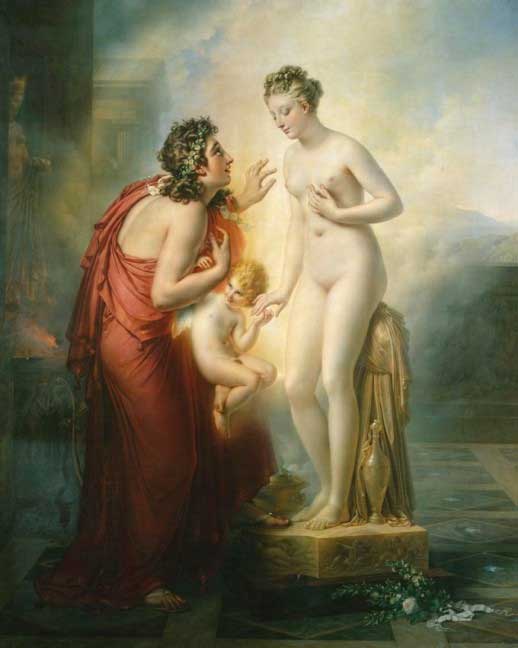
Pygmalion was a Greek artist who built a statue so beautiful that he fell in love with it. Appealing to the gods for reprieve from his unrequited love, his statue Galatea was brought to life by Aphrodite. They married and Pygmalion was able to spend his life with his creation. Many variations, plays and films, have emerged from this myth, where different variations on "brought to life" have emerged. A notable one might be the recent film, Her, where Joaquin Phoenix falls in love with the operating system in his phone. His phone, as an object, came to life with a personalized, teachable, intelligent female voice. In a brilliant dualism, Phoenix even has a sexual experience with Samantha less creepy than phone sex he previously performed with an actual person. Pygmalion is the myth of object-love, in opposition to Narcissus as the myth of self-love. Physical and emotional eros is directed as certain people and objects that epitomize how people can love.
Pygmalion discovers that Galatea is now human. Image retrieved from this site.
Currently on display in The Lourve, Paris.
The two forms of libido and love: inward and outward come together in the selfie. This new trend in photo-taking simultaneously emphasizes the importance and singularity of the individual and glorifies the technology that allows the self to be captured and spread so easily and prolifically. This is particularly apparent in images that also show the camera in a mirror as opposed to a front facing camera shot. The phone is immortalized in partnership with the individual, a perfect union of self- and object-love. We love ourselves, so we wish to capture our image and likeness. We love our technology, so we capitalize on its capabilities to connect ourselves with the world. As in Narcissus and Pygmalion, the love is often an aesthetic, physical love for appearances, than a deeper emotional love as is lauded in Plato's Symposium.
To worship ourselves, we fall into the phone's lens which collapses Narcissus's river. Our phone becomes our partner, come to life in its utility, friendship, and closeness. People cannot be without their technology, phones at their sides or in their hands, preferring the reflective screen to the faces of people around them. Some may say that like Narcissus, we will waste away focused on ourselves, individuality, and narcissism that restricts us from progressing or experiencing the world. Some may say that like Pygmalion, we are too emotionally and physically involved in our technology that we miss the beauty of the world around us in favor of a Google search for its likeness. In my cursory experience with selfies, I take very few and have posted even fewer, I see many positives and negatives to the phenomenon.
Comic by The Oatmeal about the negatives of selfies
Undoubtedly, it has taken news media by storm. The selfie of Obama and Biden made headline news and people were discussing the Oscar selfie (which was potentially a contrived Samsung advertisement) almost as much as the award winners. I'm not sure about the wide appeal of other people's selfies (in the immortal words of Mallory Archer: why would anyone want a picture of someone else's food?), but as a personal expression of self-worth, confidence, and creativity, selfies do have an important role in the rhetoric of identification. Especially considering that some people may not always find themselves presented in media (or they are expressed negatively), online, or in safe spaces, selfies could help establish an online presence and carve out spaces for open discussion about personal identification, labels, and communities. Selfies create visibility, are unapologetic, and bluntly express one's visual appearance, identity, and existence as important and worthy of appreciation. Even if it is produced for personal consumption, it necessary sharing (often on social media sites) encourages a reflection of how it may influence a larger public. The physical presentation of the body demands attention, space, and gaze onto individual, their stories, and potential arguments. The selfie also glamorizes the power of technology, to turn what would have taken many hours of labor to produce a self-portrait can be accomplished in seconds and sent around the world instantaneously.
I hear the cries on both sides about the narcissism and objectification that is implicit in the selfie. But, I see the selfie as merely an offshoot of these larger cultural changes than a root cause or responsible for them. There are innovative potentials in how the selfie could carve out rhetorical communities, enhance identities, and change norms of personal expression. Though I can imagine Kenneth Burke terrified by the reliance on technology that he warned against, I hope that he might appreciate the rhetorical opportunities for identification, mimicry, and understanding between people that may otherwise never have met. And, the rhetorical opportunities for personal expression and control over how one defines themselves and their relation to the world.
Given the tumultuous and often contradictory natures of religion and the environment, the creation care movement has arisen in an unusual predicament. Guided by religion and undeterred by previous difficulties, creation care members seek to unite a moral obligation to the environment with climate change advocacy. This new movement operates in an important gap, often appealing to the youth, that could offer appealing solutions and arguments for grassroots progress on the environment. Interested in the opinions and demographics of this group, I performed an online survey of members on a few creation care mailing lists. In this post, I will discuss a few of the open-ended answers that were particularly interesting. This week, I am examining answers to one question about the compatibility of science and religion. Future posts will look at apocalypticism, interpretation of biblical verse, and optimism about the future.
60 participants completed the survey and 52 submitted complete responses. A few prominent patterns emerged that provide insight into the beliefs of creation care members. These responses could not be generalized to the entire creation care movement, and the Judeo-Christian creation care movements are certainly far different from other iterations such as Muslim or Hindu creation care. But, the prominence of these patterns do indicate the possibility of shared opinions and frameworks for future inquiries. Overall, survey takers were confident about their knowledge of climate change and its consequences. They also expressed a mix of worry and hope towards the possibility of mitigating climate change's consequences.
Survey takers were asked about the compatibility of science and religion. After coding for compatibility, unsure, and incompatibility, there was a consensus among the 52 surveys. All participants responded that they saw science and religion as compatible. Although it is common for scientific and religious frameworks to be in competition with one another, these creation care members viewed them as completely compatible. There are some religiously-oriented climate denial groups, such as the Cornwall Alliance, that undermine efforts to protect the environment. Oftentimes, a belief in climate change is associated with denying God's ultimate power over the apocalypse. Associations with religious identity and conservative politics often encourage thinking monetarily instead of environmentally. The respondents, though, who identity as members of creation care groups, do not fall along traditional correlations. Participants identified across the political spectrum, but they all agreed on the importance of protecting the environment because of underlying religious identifications. Science and religion both support the potential risks and encourage action. Skepticism and doubt can cause pervasive apathy and negative consequences that creation care has found a way to overcome.
One respondent noted that "science and religion are best friends." One commented that "they are completely compatible and if they appear to not be, then there is an error in the interpretation of the religious truth or of the scientific data." This respondent believes that it is not possible for science and religion to be contradictory. Many respondents echoed similar themes about finding God's work within scientific inquiry. "Science is an explanation of how God works and allows me to become more deeply rooted in Him and his beauty." Another simply wrote, "Science is Man's search for God in Nature." The closest a respondent got to noting incompatibility was the statement, "sometimes they are cranky with each other."
Responding to security concerns regarding an on-campus shooting in the fall of 2012, the University of Southern California (USC) built a chain-link fence around its campus for the start of the 2013 spring semester. The main section of USC’s University Park Campus was enclosed and ushered in with it new security protocols. Previously, the campus was a free space to walk through at any time of day. Now, anyone wishing to enter campus must negotiate the new openings around the fence. USC affiliates and visitors alike are subject to the gaze of security guards who check identification at specified gate entrances after 9pm. In spite of USC’s presence that extends outside of the main campus area, community members and non-USC affiliates are restricted from accessing campus spaces. The previously unfettered access of the community to campus spaces has been replaced by prominent visual and physical barrier to movement and agency. The
fence has been justified as a security measure to protect students on campus
during certain hours. USC does have a primary importance in protecting its
students, but choosing to isolate community members because of a few
representatives influences the entire community. The consequence of such a
symbolic action is to conflate a few violent individuals with the community and
to reinforce narratives that off-campus spaces are not safe. This physical
division operates as a linguistic turn from the USC community to USC vs. the
community. This “us vs. them” mentality occurs through labeling the community
as separate from USC affiliates. Carrying a USC ID card provides one access;
without it, bodies are turned away and disciplined from entering. In creating
this distinction, the community is labeled as violent, criminals, trespassers,
unwelcome, and the other. “These names shape our relations
with our fellows. They prepare us for some functions and against others, for or
against the persons representing these functions. The names go further: they
suggest how you shall be for or against” (Burke, 1984, p. 4). The fence helps
establish hierarchies in naming that teach USC affiliates how to respond to and
treat community members. These rules only operate between 9pm and 6am, but the
labels last longer. Symbolic naming reconstructs the relationship between the
community and USC that cannot be changed by the hour of the day.
In
restricting the movement of the body, USC also controls when those bodies can
be seen, have a presence, and occupy certain spaces. Control over the body, or biopower
and biopolitics, is a power over the movement of the body, its ability to be
seen, and to be heard (Foucault, 1982; Hollinshead, 1999).
Casper and Moore (2009) refer to “hysterical blindness” where institutions or
people either choose not to or are somehow restricted from seeing or being seen
(p. 10). “Hypervisuality” is this opposite, where people are targeted, heavily
observed, and monitored (Casper & Moore, 2009, p. 10). This “complex
system” of sight and obstruction means that powerful political entities can
control who can see and who is seen (Casper
& Moore, 2009, p. 10). At USC, bodies of students become
marked, by carrying a marked ID, and those of community members unmarked as the
“other,” not welcome within campus spaces (Phelan, 2004). Visitors to campus can apply for single-entry access for a
specific purpose, creating a temporary mark of approval and access by
institutions of power. The body receives either acceptance or denial at the
fence border based on its membership in the Trojan Family. As Greg Dickinson (2002) notes, “the subject comes
to known itself in some more or less coherent way depends on an ability to
locate itself” (p. 7).
Locating oneself either inside or outside of the campus borders changes how one
defines membership, identity, and body autonomy. Knowledge of surveillance by
guards also contributes to one’s ability to locate oneself within the political
power structure as a target or threat worth monitoring.
There
are concerns that these policies endanger community members while offering
little extra protection for USC. Vice President of Student Affairs Michael
Jackson published an updated campus policy online that said, “We are taking these steps because we care about the security
and safety of our students, faculty, staff, guests and neighbors” (para. 4). It
is an interesting rhetorical decision to separate “guests” of USC from its
“neighbors,” but certainly these are fluctuating categories. The real
importance in this statement is that somehow the construction of the fence will
not only add protection for USC affiliates but also to the community members.
To the contrary, the
Los Angeles Times reported on January
13th, 2013, that blocking the USC campus off from non-students,
faculty, and staff poses a risk to community members. For example, community
members exiting the Exposition/USC stop on the new Metro Expo line used to be
able to walk through “the safe, well-lit
shortcut through campus” to catch buses at prominent Jefferson Boulevard stops (Jennings
& Xia, 2013, para. 9). Now, community members have to circle the entire USC
campus or change their regularly traveled public transportation routes home. The
construction of the fence not only places the community under additional
surveillance, but it also directly influences the movements of the community,
with yet unseen benefits for USC. A Daily
Trojan letter to the editor echoed these concerns noting that “as a university we should not sacrifice freedom of movement
for relatively little or no added security” (Brown, 2013, para. 4).
Though
erected and implemented for supposed safety and benefit, borders oftentimes
exacerbate economic, class, and racial divides by establishing rhetorical
divisions in identity and membership. How bodies are restricted in their movement,
displaced, or undervalued also restricts voice and visibility in terms of the
powerful and the powerless. Surveillance, monitoring, and the construction of
boundaries are all ways that bodies are disciplined and controlled. These
barriers to full cooperation and integration, both physical and symbolic,
construct an environment where identity is defined through one’s relationship
with institutions of power. USC’s fence highlights the modern implications of
race, borders, and visibility, where hierarchies still enact biopower and
violate political autonomy.
A Change.org petition has been started to “Take down the USC gates.” This
petition notes the importance of welcoming, opening spaces, and condemn the “us
vs them” mentality that the fence represents. The petition includes a space for
comments and a letter addressed to USC President Max Nikias and the Provost
Elizabeth Garrett. The petition is nearing the 500 signatures needed to be sent to Nikias and Garrett. The power of
such a petition may be limited in terms of practical changes, but the petition
is itself symbolic that the USC community is in part against the policy instituted by
the administration. A lack of student support and involvement, however, many indicate that many are already accustomed to the surveillance and limitations that it imposes. Some may be optimistic about the future of surveillance,
but it appears that great action and effort to shift notions of visibility are
needed to reclaim privacy and personal autonomy.
References
Brown, N. (2013,
January 22). In response to security measures. Daily Trojan. Retrieved
from http://dailytrojan.com/2013/01/22/letter-to-the-editor-75/
Burke, K. (1984). Attitudes toward history. Berkeley, CA:
University of California Press.
Casper, M. J., &
Moore, L. J. (2009). Missing bodies: The politics of visibility. New
York, NY: New York University Press.
Dickinson, G. (2002).
Joe’s rhetoric: Finding authenticity at Starbucks. Rhetoric Society
Quarterly,32(4), 5–27.
doi:10.1080/02773940209391238
Foucault, M. (1982).
The subject and power. Critical inquiry, 8(4), 777–795.
Foucault, M. (2012). The
history of sexuality: An introduction. New York, NY: Random House Digital,
Inc.
Hollinshead, K. (1999).
Surveillance of the worlds of tourism: Foucault and the eye-of-power. Tourism
Management, 20(1), 7–23. doi:10.1016/S0261-5177(98)00090-9
Jennings, A., &
Xia, R. (2013, January 15). USC rolls out the unwelcome mat. Los Angeles Times. Retrieved from
http://articles.latimes.com/2013/jan/15/local/la-me-usc-safety-20130116
Phelan, P. (2004). Unmarked:
The politics of performance. New York, NY: Routledge.
I'd previously wanted to title this: Words you shouldn't say anymore, but I changed the title to reflect how my opinions aren't those of everyone. Prescribing language changes for all people, though I believe that these are respectful and accurate changes, is problematic for many reasons. These suggestions are more for people who are already in line with my beliefs, namely liberal ones, and how to adjust your language choices to be more respectful of others and values.
Racial slurs: First of all, my previous post on Django referenced this briefly, but racial slurs are not appropriate in every day use. This primarily applies to the non-African American, black, brown, or identifying groups that may use racial slurs in jest, for shock value, or as a political statement. They are not words that most of us should or can say, by re-appropriating them into white vernacular, they lose their political meaning and importance. Simply put, these words can be used to reinforce power hierarchies and should not be used lightly or at all by dominant groups.
Tarantino Responding to Criticism about Django
Pro-life: This term has bothered me for a long time. What exactly is pro-life about banning women from having abortions? Abortions can be a life-saving procedure and refusing one can lead to complications and death. The idea that a fetus is alive is based on religious definitions that life begins at conception. For non-believers or those that operate under a different definition of when life begins, the life of the mother is the life that needs to be protected. The life of the mother is not always immediately in physical danger, as was Savita Halappanavar's, but there is always emotional and psychological life to worry about. Although many pregnancies are intentional, women do become pregnant for many reasons accidental or through force. Denying these women the right to closure and healing from rape, incest, or other emotional traumas can be damaging to a woman's life as well. Instead of "pro-life" which I have described as very misleading, I endorse the term "anti-choice" to emphasize the true issue: deciding for women what they wish to do with their bodies. If life were really the issue, then the woman's life would weigh importance as well, which for many anti-choice groups, though not all, it is of secondary importance, if that. Perhaps the most disturbing part of the anti-choice movement is that by equating the fetus with a child, they respond to abortion clinics and places like Planned Parenthood as if they were attacking murderers. Abortion practitioners have been threatened and killed (pro-life, huh?) and funding for PP has been cut in many states.
Savita Halappanavar
English in general: I recently read an amazing chapter from bell hooks who discussed the emphasis on clean, pure English as a means of stripping people (primarily former slaves and their descendants) from keeping in touch with their roots through dialect. She quoted a poem by Adrienne Rich saying, "this is the language of my oppressor, but I need it to talk to you". This statement is powerful and I feel needs no explanation or extrapolation except to say that the hegemony of the English language is not something always laudable. We should all try to learn other languages and encourage others (as bell hooks describes in a teaching role) whether they be friends, family, or students to speak how they feel comfortable speaking and encourage expression in multiple voices.
Boy/girlfriend, wife/husband: I think that these words should be replaced with the gender neutral counterparts of "significant other", "partner", "spouse", etc. Assigning and using these terms reinforces heteronormative definitions of marriage that use the binary gender terms, male and female, as the standard. Despite setbacks, such as Proposition 8, marriage is on its way to being redefined as open to homosexual couples. To reflect this openness and one's agreement with the changes, more gender neutral terms should be used to describe couples. Some homosexual couples may prefer the girl/girl friend or boy/boy friend terms, and that should be respected. For general conversation, however, the gender neutral terms are more encompassing and respectful. This gender neutrality follows for trans* and members of the queer community. Pronoun and name usage is something that I am still struggling with, but I find that simply asking for one's preferred gender pronoun is the best option. For some, their outward appearance may not reflect where they are on their personal journey of identification and which gender pronoun they would prefer. One's sexual organs does not adequately describe most people's gender identities and can be restricting in terms of expression. I remember hearing a quotation from a friend at an LGBTQ event at Northeastern: "I wish I had been born a girl, instead of just having this vagina." This statement highlights the struggle of many people attempting to realign their physical gender with one's felt gender and how sexual organs should be not be defining characteristic of a human being.
These are a few suggestions for different word choices that I think might be helpful for more open, liberal-minded people. For people who are anti-choice, pro-heteronormativity, and perhaps unconcerned with issues of race, these suggestions may fall on deaf ears. For others, I hope that these at least spark some thinking about the power of the words that we use, what context we use them, and who we use them with in defying hierarchies and promoting equality.
In honor of Transgender Awareness Week in Boston, I wanted to discuss some ideas about gender identification. Although there have been great strides in marriage equality and LGBTQ issues, the transgender population and their issues are often left out of the conversation. In part, I find the inclusion of LGB with T a partial misnomer. Whereas lesbian, gay, and bisexual individuals are looking for acceptance based on sexual orientation, the transgender community is more concerned with gender norms and obstacles to identification. For example, the issues each group is concerned with varies greatly. When I lived in Boston, I remember regulations being discussed for allowing transgender people to enter bathrooms that may not correspond with societal norms. This was a large issue at the time, but would not an issue for an LGB individual, who would not be barred from entering a public bathroom.
When I consider issues of gender, I cannot help but think of reading I did for my summer project on the relationship between science and religion. Gender is a scientific and religious construction that defines gender as a binary and by physical characteristics. Even though modern science dictates gender as a more fluid identification, past categories have constricted gender expression into arbitrary labels fueled by religious needs for procreation. The first fact established about a person is their gender. Consider the first knowledge gained by a pregnant couple, even before the name, eye color, or personality, the parents know the child's gender in a male/female dichotomy. This piece of information determines color schemes for bedrooms, gifts for a baby shower, naming conventions and decisions, and expectations for the birth.
Simply put, one's gender is decided for oneself and becomes the defining factor for identity. Incongruity with a personal belief and experience and what has been provided for someone by others can create drastic psychological issues that can lead to destructive behaviors. As seen in the statistics below, transgender people are at risk for certain behaviors and are at risk for being treated differently because of their gender identity. I think it is important to remember how life-changing such an identity crisis may be. People are not simply changing their hair color, but they are undergoing a personal restoration to how they feel is the appropriate, representative, and correct gender, or anywhere along the spectrum.
When people do not conform to these gender norms, society's discourse breaks down. Scientific, religious, and public discourse is only beginning to establish terms that break the binary and are truly representative for all people. The inability to express oneself, partially because of hegemonic discursive structures that restrict fluid definitions of gender. The way that society is structurally organized leaves little room for open spaces to discuss the body (e.g., at a doctor's office), naming transitions (e.g., at a university or with the government), or protection (e.g., with the police). The problems that face transgender people are still only on the horizon of LGBTQ concerns, but I hope that in the future, as more strides are made for LGB individuals that transgender issues will become more prominent. Leaders in this area should be lauded as they are paving the way for other people and politicians to become more aware of transgender concerns.
Arguments over the beauty of models has become under greater scrutiny with the use of Photoshop. Images and visuals, traditionally considered "truthful" as they show reality before the lens, can now be manipulated pre and post photo shoot. Many websites have made their focus highlighting Photoshop mistakes, the drastic differences in appearance when celebrities are "caught" without makeup, and how makeup and photoshop exaggerate the beauty of models.
JennaMarbles: How to Trick People into Thinking You're Pretty
Disclaimer: minor foul language
But how offensive are these "lies" and "manipulations"? What damage is caused when ideals of perfection are unreachable? Backlash from the over-usage of make-up and photo-editing tools call into question the health and well-being of youth, especially young females, who may feel pressured to perform dangerous activities to keep pace with media images.
Communities such as Pro-Ana and Pro-Mia groups (advocating, providing information about, or discussing anorexic and bulimic lifestyles) and "thinspo" or "thinspiration" groups are becoming more prevalent in online spaces. The accessibility and limited rules of the Internet allow for previously sequestered, shamed, or otherwise isolated groups to connect in open, free access spaces. These groups oftentimes detail strict dieting plans, workout routines, or glorify thin bodies in their quest for "perfection". Are the exaggerated and fake images in the media responsible for such behavior? Do they initiate or augment feelings of inadequacy in the population?
I find myself being drawn to Erving Goffman's presentation of self where he discusses the front stage and the backstage performances in the theatre of life. One's front stage performance is the act we put on in our every day lives, how we express and communicate ourselves to others. The backstage performance can be considered our true selves, or the identity that we hide, shield, or keep from others. The congruency between a front and backstage persona is often unachievable, as people are always trying to put their best foot forward and hide flaws (e.g., consider job interviews, politicians, dating, etc.). When the front and back stage do not match, or is revealed to be incongruent, one's identity and performance is questioned and mistrust, skepticism, and cynicism flourish.
Are these models not the same? The industry and media standards for beauty have literally become impossible. Even models and actors hired for the beauty can no longer meet the standards and must inflate and exaggerate their features through cosmetics or computers. And when their "true" identities are revealed or captured, there is ridicule and shame brought upon them. Can we truly fault these models for working? For meeting the requirements of their jobs? Perhaps this is an issue of the industry and the larger culture. So do we all not share the responsibility in creating and fostering these ridiculous beauty standards?
Part of me thinks that this is a good thing: when perfection is unobtainable, then the search for it can be forgotten. If models and celebrities cannot be perfect, surely no one can be, at least in current standards for beauty. When size 4 models are photoshopped to remove extra fat, when computers are altering cultural and racial representations of beauty, then can't the fight for perfection finally end?
Unfortunately, the issue is one of awareness and knowledge which is echoed beautifully in this article about a 14-year-old who is fighting back against photoshopping. Her criticism of photo manipulation stems simply from ignorance on the part of many that these levels of beauty are faked. In response to this lack of information, many organizations and countries have begun placing increased standards on media images because of the perceived health risks in exposing youth to harmful images (female and male alike). Israel, for example, has required advertisements to place disclaimers on advertisements that are photoshopped and all models have to provide a doctor's approval that they are of a healthy weight before working (i.e., to work in Israel, a model's BMI has to be above 18.5).
Even Pinterest, a site that has come under scrutiny for its large "thinspo" community that posts pictures of thin models and anorexia diet plans now places this disclaimer on "thinspiration"-themed searches:
Eating disorders are not lifestyle choices, they are mental disorders that if left untreated can cause serious health problems or could even be life-threatening.
For treatment referrals, information, and support, you can always contact the National Eating Disorders Association Helpline at 1-800-931-2237 or www.nationaleatingdisorders.org.
People are no longer free to establish their own standards of beauty, but are labeled as unhealthy or mentally ill because of their physical preferences. Should transgender individuals feel the same way because they alter their appearance against the "norm"? How about other cultures that may bind feet, stretch their neck, or brand members in a search for beauty? These are all serious questions for our world, because while we are a nation founded on choice and free speech, there are situations where the health and well-being of our citizens requires, necessitates, and deserves intervention.
The journey to stop such glamorization of thin frames, anorexic bodies, and manipulations of beauty have only begun. I can only say that everyone should define beauty their own way, without the undue influence of the fashion and modeling industries, media images, and peer pressure.
Consumption and food are not new contributors to political identities, but one may imagine it is so considering the multitude of coverage surrounding the Chick Fil-A "eat-ins" and political denouncements. The old adage, "you are what you eat" echoes common academic themes of consumption outlining important characteristics of someone. Eating is something that people do consistently, and even the absence of eating communicates political, social, and personal values.
As a vegetarian, I have had my entire life of experience defending my choice of following a specific dietary habit. Refusing meat, questioning waiters at restaurants, and scrutinizing ingredients lists are often activities that I have to defend or justify as outside of the norm. People are vegetarians for multiple reasons, often attributing actions to animal rights, environmental concerns, allergies, and religious restrictions. For me, my vegetarianism is a product of tradition and family, being raised a vegetarian since birth and eating and cooking in the vegetarian lifestyle is an important part of my family life. For any reason, removing certain parts of a diet begs the question of explanation (and sometimes inclusion of certain foods, such as cultural foods). These questions would not be necessary unless one's choice in consumption were meaningful or symbolic.
This relationship has risen to great importance and attention in the media with the recent discussion of Chick Fil-A's support of traditional marriage groups and anti-homosexual groups. The politics of the organization has encouraged politicians, celebrities, and the general public to associate their products with their ideologies. Similar reactions have plagued organizations that participate in child-labor, unfair business practices, or are unfair to their employees. Boycotting has been around since the creation of the United States, when people refused to purchase items that were unfairly taxed. What, then, is the issue with Chick Fil-A boycotts and the discussion at hand?
I don't necessarily think that there is anything inherently "wrong" about the Chick Fil-A argument. I would rather media attention be focused on the rights of the LGBTQ community or contextualize these discussions within the larger battle for universal rights and marriage equality. Instead, news reports are often solely focused on the actions of individuals and the organization as opposed to the cause that is driving the discussion. When the news reports become overwhelmed with free speech and balancing the scales by allowing both sides their viewpoints, the actions of Rahm Emanuel and Tom Menino are undermined and discredited.
The most important part of these demonstrations is the power of the individual. Through simple actions such as spending money, kissing, and eating, bodies act as rhetorical tools for the creation and expression of identity. Even if I did consume meat, I would have been happy to participate in the Chick Fil-A boycott, using my consumption, or lack thereof, to complement my political and personal values. Although I admit I was skeptical of the ban at first and questioned its fairness, I am now proud of my alma mater, Northeastern University, for banning Chick Fil-A's establishment in our student center. Banning Chik Fil-A represents the importance of the LGBTQ community on Northeastern's campus, which recently approved general neutral housing, preferred name and pronoun identification, and multiple student groups and training groups for inclusiveness on campus.
Instead of allowing for the power of consumption to force the Chick Fil-A to leave, Northeastern used its political power to avoid the issue altogether. The issue, then, becomes when people are willing to consume, purchase, and use their bodies as supporters of hate, bigotry, and exclusion and are defended as heroes of free speech. In that world, our world, change will be slow and riddled with obstacles. Recognizing the power of consumption and encouraging people to eat consciously may be part of the solution towards equality and empowering businesses as political entities.