Showing posts with label authenticity. Show all posts

Monday, November 30, 2015

Penn & Teller: Social Comedy and Edutainment

This past week, I was in Las Vegas, Nevada for the National Communication Association conference. I participated in a great pre-conference on sustainable communication, saw fabulous panels in rhetoric, religion, and science, and was honored to see a former student shine at her panel on material space and architecture. In the evening, I was able to explore some of Las Vegas's shows and strip night life. I attended Penn & Teller's show at the Rio Saturday night and knew immediately that I wanted to write a post about it. In this post, I will discuss some of my favorite tricks from the show and also my thoughts about the political, social, and scientific commentary that highlighted for me the importance of educational entertainment. I do not mean to give "spoilers" or to ruin the magic for anyone, so read at your own risk.

Retrieved from this site.
My first observation of the show was how honest and open Penn & Teller were about the art of deception. Many times, they blatantly told us what they doing and yet we were still bamboozled and confused. For example, Penn gave a speech condemning "psychics" who use tactics of cold reading to make audiences think that they have supernatural powers. Penn called out John Edward and Sylvia Browne, for example, for capitalizing on people's pain and misery in giving false hope through magic masquerading as messages from people who have passed. Penn has prepped us then, that what he is doing is really a trick. But, he does the readings so quickly and so spectacularly, it's really a wonder how he does it at all. In fact, being prepped and reminded about how the show is entirely full of tricks elevates one's awe and wonder because it has a natural explanation. If the answer is supernatural, then it is the supernatural power that is impressive, not the artist.

Retrieved from this site.
One of the themes of the show was represented on a sign that Teller held up during one of the tricks: "We aren't doing the trick you think we are doing." He flat out tells the audience that deception is occurring and Penn & Teller cannot be trusted, and yet the audience still falls for the trap, time and time again. My favorite trick was relatively simple in its set-up. Teller chose a woman from the audience and gave her a coin jar. He then began picking water drops from a fish tank and turned them into pennies which he placed in the jar. Even though I was in the very back corner of the mezzanine, I could still see and understand the tricks easily as they happened. The trick ended with Teller picking up a handful of pennies and dumping them back into the water. Instead of the pennies turning back into water, however, they sank to the bottom while dozens of goldfish appeared in the tank - it was truly incredible.

Retrieved from this site.
Part of what I was not expecting was the prevalence of social and political commentary in the show. Penn & Teller are widely known as libertarians and Penn is an outspoken public atheist. One trick included a short speech by Penn about airport security using a TSA metal detector. The trick was, again, amazing, but it also gave the audience an opportunity to reflect on the sacrificing of values and the usefulness of the TSA. Penn noted that the audience member chosen to come up on stage had as much training as a real TSA agent. They also showed how inaccurate and thus unnecessary many of the practices are. My favorite part of the sketch was Penn summarizing that we should all think about how our temporary security is often valued more highly than our eternal liberty. This is the type of comedy that reminds me of Lewis Black, where the jokes are purposeful and cause us to reflect on larger social issues.
Retrieved from this site.
This activism-comedy was also apparent in Penn & Teller's card trick. Teller performed sleight of hand magic while Penn played a guitar and told a story about "The Atheist's Deck of Cards." Based on a song by Tex Ritter, Penn & Teller tell the story about an audience member (Teller) who interrupts a physics lecture by Lawrence Krauss (who helped them write the song) and then tells a story using the cards to justify having them at the lecture. I was blown away by the amount of scientific information (which my partner, who is earning his PhD in Cosmology confirmed for me was accurate) packed into the song. From the four fundamental interactions in nature, the cosmological constant, and the size of the universe, the audience were learning about physics while also being mesmerized by Teller's sleight of hand.

Retrieved from this site.
I highly recommend Penn & Teller's show at the Rio. I'm not trying to advertise for them nor am I getting any reimbursement for this review. I am simply hopeful that Penn & Teller, along with other types of "edutainment" can help everyone learn more when they are not expecting it and give audiences chances for reflection and advocacy. Entertainment has aspects of education and can be harnessed to create a more active, engaged public. In a city known for its debauchery, sinfulness, and extravagance, I felt the simplicity and insight of Penn & Teller's show a welcome change of pace.

Sunday, September 7, 2014

The Online Activist: Making Charity Cold as Ice

There have been many commentaries on the ALS Ice Bucket Challenge, hereafter IBC, including some by my colleagues at Annenberg. I have very mixed feelings about the challenge and they are quite scattered. I will attempt, then, to parse some of my more scholarly opinions on the matter in my overall criticism of the challenge as an event in narcissism and exploitation that has ultimately generated a lot of money for a great cause. In this sentence, I want it to be clear that the process by which these donations are raised is where my primary concern lies and not with the cause itself. Certainly, encouraging donations is a positive enterprise, but I am not completely deontological in that I feel that a critical look at the process and means by which these are obtained are necessary.
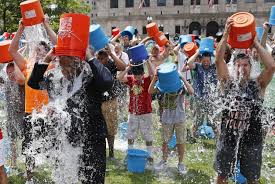
Retrieved from this site.
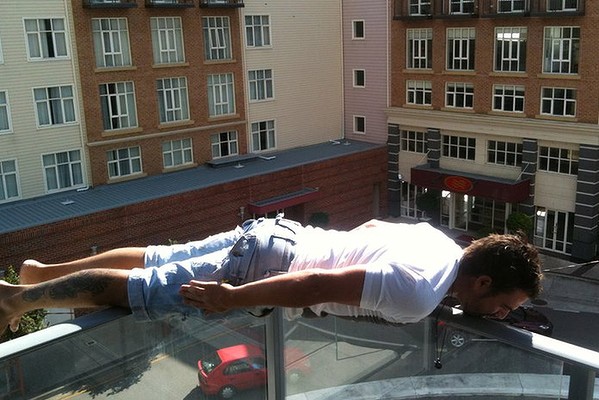
My first issue with the IBC is the notion of "challenge." There has been an increase of challenge and dare activities on the Internet where people are constantly trying to one-up each other. We had planking, for example, where people would try and lie supine on random objects, often in danger. The more dangerous or precarious the planking, the more valuable in terms of Internet clout. Then, came the video challenges by which people were dared to do something inherently dangerous, like jump off a bridge. Not surprisingly, this resulted in the deaths of a few people after drowning trying to meet the dare. Though meant as harmless fun (of which even my lovely siblings have participated in), these challenges raise important questions of safety and what activities the Internet are encouraging off-line. Others have been injured in so-called "cold water plunges" that are often media stunts to raise money for charities or certain causes. These challenges raise questions of agency and the choice of the "dared." When we are really talking about life and death, how can we not see challenge culture as a negative aspect of the Internet that encourages risky and dangerous behavior?

Planking on the edge of a building. Retrieved from this site.
These "I nominate X, X, and X" phrases remind me of the chain letters of the 90s where you had to forward these ridiculous stories (in Yahoo and Hotmail, typically) or someone would come kill you in the evening. What actually happens if you don't accept an IBC, cold water challenge, or forward a chain email? Absolutely nothing. The challenge culture simply takes your unwillingness to do a dare from middle school slumber parties to a global audience. In a word, it's childish. The maintenance of these challenges perpetuates the dangerous culture of one-upping and daring, although not specifically present in the IBC. What we communicate has essentially stayed the same, but how we communicate it has changed. Ong would see the evolving communication technologies as simply offering new forms that communication can take, such as the dare. The IBC has the countdown clock and the threat of non-compliance that email chains (and blackmail, by the way) have to motivate people to act. The dare takes the spirit of altruism out of the donations, because it is reduced to the act of one-upping others, blending in with the crowd, and passing the dare on to others.

My second issue is the notion that this particular charity is particularly worthy, or that I am forced to donate to this particular one. I think that donating to charity is definitely a worthwhile cause and one that the IBC has reminded me that I should do more of. But, why ALS? They have simply come up with this marketing campaign. They, like all charities, are not particularly worthy or more deserving than so many other of the great charities out there that one could donate to. Why should my choice in charity donation be limited because of a "dare" I receive on Facebook? Why shouldn't I donate to a charity that I care about? That I believe does good work? That I feel is not getting enough attention? Perhaps I have been personally affected by close family member having Alzheimer's or diabetes and wish to donate to them. Is this somehow less acceptable because I am not performing the dare made of me? Why should someone else decide where I give my money? This article brings up important concerns about what the money will be used for and the benefits of massive donations to a specific charity (especially one like ALS which focuses on research and impacts very few people).

Retrieved from this site.
My third issue is the performative aspect of the challenge that promotes narcissism and exhibitionism rather than a concern for the charity. Why should I have to dump water on my head to do a good deed? Not to mention the many concerns this has raised in California because of the drought. Why do I have to film it and share it with others? Why isn't donation a private act that doesn't need public display? Because it's not about my donation, it's about me. It's about my public performance of doing good work. Modern culture cannot do a good deed without getting recognized for it. We need public recognition of every A, every act of kindness, every charity. Dumping water is about including myself in the story of ALS and its success, about feeling good about my involvement. The IBC reminds me quite strongly of the "Fitch the Homeless" movement where people donated all of their Abercrombie & Fitch clothes to the homeless. On the surface, just like the IBC, this campaign did provide many donations of much-needing clothing for the homeless. But, this campaign leaves a similarly negative taste in my mouth because of the reasoning behind the actual donations. They were not out of the sake of the good deeds or that the homeless were in need, but that we were getting back at Abercrombie & Fitch CEO would made comments about his clothing being only for "cool kids." Yes, in response to this statement, let's donate all of the Abercrombie & Fitch clothing to the most non-cool kids ever. As this article put it: "what [this campaign] ends up doing is using people experiencing homelessness as pawns to make a political statement." The IBC similarly exploits the narcissism and dare culture of the Internet to encourage donations. Is the end result a positive? Definitely. But should we condone these types of reasons to donate? Absolutely not.

Retrieved from this site.
Donations are not a matter of being dared or used as a way to spite others. Donations should be about caring, giving, appreciating others, working monetarily towards a cause that you believe in. If this is the new way that people donate, then it changes the dynamics of charity, and may shift our thinking so that we require dares and challenges to make a donation. We couldn't act independently or privately for the benefit of a cause, but would need to publicly present ourselves and declare that others must congratulate or copy us in order for the good deed to be meaningful.

I want to reiterate that I think the donations raised about the IBC are absolutely amazing. I never would have thought that reinvigorating the giving spirit (sort of) especially for my generation could be done so successfully (especially after the Kony 2012 disaster). I think that the impassioned speeches of my colleagues on Facebook have been well heard and I do not look down or condemn anyone for doing the IBC. I merely wish to raise questions (albeit rather passionately myself) about the purpose of these type of videos, what they are actually promoting, and the motivations behind the good deeds that make me skeptical of the lasting power of this campaign and others that may try to imitate it.

I will not participate in this if someone challenges me. I've decided that I don't want to perpetuate a culture that made my brother jump off of a bridge, take away people's agency in deciding to donate, or reducing the act of charity to an event in narcissism. I do think that donations are a positive act and this challenge has caused me to see that people don't donate enough. I may donate because of this, I may not. It may be to ALS, it may be to a different charity, or none at all. But, I will not make it a public spectacle or "dare" others to have the giving spirit or shame them into performing for a Facebook audience. Instead, I encourage everyone to see the larger message in the beauty of charity and reject the process by which this challenge is perpetuated.

Wednesday, September 5, 2012

Supermodels Without Photoshop: Goffman's Presentation of Self

Arguments over the beauty of models has become under greater scrutiny with the use of Photoshop. Images and visuals, traditionally considered "truthful" as they show reality before the lens, can now be manipulated pre and post photo shoot. Many websites have made their focus highlighting Photoshop mistakes, the drastic differences in appearance when celebrities are "caught" without makeup, and how makeup and photoshop exaggerate the beauty of models.

JennaMarbles: How to Trick People into Thinking You're Pretty
Disclaimer: minor foul language

But how offensive are these "lies" and "manipulations"? What damage is caused when ideals of perfection are unreachable? Backlash from the over-usage of make-up and photo-editing tools call into question the health and well-being of youth, especially young females, who may feel pressured to perform dangerous activities to keep pace with media images.

Communities such as Pro-Ana and Pro-Mia groups (advocating, providing information about, or discussing anorexic and bulimic lifestyles) and "thinspo" or "thinspiration" groups are becoming more prevalent in online spaces. The accessibility and limited rules of the Internet allow for previously sequestered, shamed, or otherwise isolated groups to connect in open, free access spaces. These groups oftentimes detail strict dieting plans, workout routines, or glorify thin bodies in their quest for "perfection". Are the exaggerated and fake images in the media responsible for such behavior? Do they initiate or augment feelings of inadequacy in the population?

I find myself being drawn to Erving Goffman's presentation of self where he discusses the front stage and the backstage performances in the theatre of life. One's front stage performance is the act we put on in our every day lives, how we express and communicate ourselves to others. The backstage performance can be considered our true selves, or the identity that we hide, shield, or keep from others. The congruency between a front and backstage persona is often unachievable, as people are always trying to put their best foot forward and hide flaws (e.g., consider job interviews, politicians, dating, etc.). When the front and back stage do not match, or is revealed to be incongruent, one's identity and performance is questioned and mistrust, skepticism, and cynicism flourish.


Are these models not the same? The industry and media standards for beauty have literally become impossible. Even models and actors hired for the beauty can no longer meet the standards and must inflate and exaggerate their features through cosmetics or computers. And when their "true" identities are revealed or captured, there is ridicule and shame brought upon them. Can we truly fault these models for working? For meeting the requirements of their jobs? Perhaps this is an issue of the industry and the larger culture. So do we all not share the responsibility in creating and fostering these ridiculous beauty standards?

Part of me thinks that this is a good thing: when perfection is unobtainable, then the search for it can be forgotten. If models and celebrities cannot be perfect, surely no one can be, at least in current standards for beauty. When size 4 models are photoshopped to remove extra fat, when computers are altering cultural and racial representations of beauty, then can't the fight for perfection finally end?


Unfortunately, the issue is one of awareness and knowledge which is echoed beautifully in this article about a 14-year-old who is fighting back against photoshopping. Her criticism of photo manipulation stems simply from ignorance on the part of many that these levels of beauty are faked. In response to this lack of information, many organizations and countries have begun placing increased standards on media images because of the perceived health risks in exposing youth to harmful images (female and male alike). Israel, for example, has required advertisements to place disclaimers on advertisements that are photoshopped and all models have to provide a doctor's approval that they are of a healthy weight before working (i.e., to work in Israel, a model's BMI has to be above 18.5).

Even Pinterest, a site that has come under scrutiny for its large "thinspo" community that posts pictures of thin models and anorexia diet plans now places this disclaimer on "thinspiration"-themed searches:


Eating disorders are not lifestyle choices, they are mental disorders that if left untreated can cause serious health problems or could even be life-threatening.

For treatment referrals, information, and support, you can always contact the National Eating Disorders Association Helpline at 1-800-931-2237 or www.nationaleatingdisorders.org.


People are no longer free to establish their own standards of beauty, but are labeled as unhealthy or mentally ill because of their physical preferences. Should transgender individuals feel the same way because they alter their appearance against the "norm"? How about other cultures that may bind feet, stretch their neck, or brand members in a search for beauty? These are all serious questions for our world, because while we are a nation founded on choice and free speech, there are situations where the health and well-being of our citizens requires, necessitates, and deserves intervention.

The journey to stop such glamorization of thin frames, anorexic bodies, and manipulations of beauty have only begun. I can only say that everyone should define beauty their own way, without the undue influence of the fashion and modeling industries, media images, and peer pressure.


Segment from National Geogrphic's "Taboo: Beauty"
Disclaimer: images of extreme anorexia