Showing posts with label Risk. Show all posts

Sunday, October 12, 2014

Dangerous Advertising and Disingenuous Controversy

Students of mine have turned in papers this week that critique different advertisements. Their papers have prompted me to think, as I have before (gender in advertising, political advertisements, religion and advertising, interactive advertising, and exclusionary advertising) about different advertisements that propose a cause or campaign instead of a product. My students had the choice of a traditional product advertisement and one form a non-profit. It was much easier to see the direct purpose of the for-profit advertisement: to sell a product. Oftentimes, however, the advertisements for non-profit groups have to be more creative in order to peddle something far less tangible than a car or a purse. These attempts to be innovative can backfire, causing more attention to the advertisement campaign itself than the message it is trying to convey.

Retrieved from this site.
In rhetorical theory, this is called disingenuous controversy. Fritch, Palczewski, Farrell, and Short proposed the term to describe situations when an ancillary aspect of an event occupies attention and the actual message (which itself could be controversial and counter-hegemonic) is lost. Their example was the comments by Ward Churchill where he compared the workers in the World Trade Center as "little Eichmanns" when describing the justifications for the 9/11 attacks. The purpose was to raise questions about the American economic structure and how it constrained and motivated the actions of the 9/11 terrorists. But, instead of this critique gaining media attention, people focused on his comparison between the Nazi bureaucrat and workers in the World Trade Center as offensive, insensitive, and unpatriotic.

Following the Nazi theme, I first want to discuss the advertising campaign that ran in Germany to promote HIV/AIDS awareness. The campaign features graphic images of infamous leaders such as Adolph Hitler, Joseph Stalin, and Saddam Hussein having sex with women. This campaign was eventually pulled in part because of its graphic nature and outrage over the use of these infamous faces in relations with women. The campaign read, "AIDS is a mass murderer" and encouraged viewers to associate something traditionally thought-of as pleasurable with something inherently disgusting and deadly. The graphic depiction in the advertisement coupled with the unique history in Germany that makes the presentation of Hitler challenging, however, overshadowed the consciousness-raising of re-thinking about the dangers of unprotected sex.

Retrieved from this site.
The second campaign I'd like to present is a campaign by 10:10, which is a climate change advocacy non-profit. The advertisement shows various situations where people are asked about their opinions on climate change. A few that declare that they do not believe in global warming or that we should not act towards it are shown exploding violently. The version that received the most attention featured children exploding in their classrooms. The campaign seemed to be questioning the value of dissenters and how those who do not engage or pay attention are ultimately doomed. The violence, especially towards children, however, became the focus of the campaign instead of the message of the future of humanity.


These "dangerous" advertisements risk an audience backlash in favor of capturing people's attention. When the alternative is complete silence or apathy, perhaps a bit of attention-grabbing is in order. There are certainly risks to this type of advertisement. Non-profits may be more likely to risk these strategies because they are not beholden to shareholders or a bottom line. When attention is at an all time premium, with the variety of options for viewing, being offensive or crude is one way to be sure one gets eyes, if not support.

Sunday, September 7, 2014

The Online Activist: Making Charity Cold as Ice

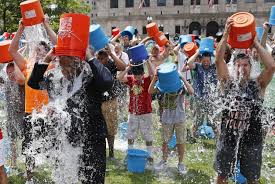
There have been many commentaries on the ALS Ice Bucket Challenge, hereafter IBC, including some by my colleagues at Annenberg. I have very mixed feelings about the challenge and they are quite scattered. I will attempt, then, to parse some of my more scholarly opinions on the matter in my overall criticism of the challenge as an event in narcissism and exploitation that has ultimately generated a lot of money for a great cause. In this sentence, I want it to be clear that the process by which these donations are raised is where my primary concern lies and not with the cause itself. Certainly, encouraging donations is a positive enterprise, but I am not completely deontological in that I feel that a critical look at the process and means by which these are obtained are necessary.
Retrieved from this site.
My first issue with the IBC is the notion of "challenge." There has been an increase of challenge and dare activities on the Internet where people are constantly trying to one-up each other. We had planking, for example, where people would try and lie supine on random objects, often in danger. The more dangerous or precarious the planking, the more valuable in terms of Internet clout. Then, came the video challenges by which people were dared to do something inherently dangerous, like jump off a bridge. Not surprisingly, this resulted in the deaths of a few people after drowning trying to meet the dare. Though meant as harmless fun (of which even my lovely siblings have participated in), these challenges raise important questions of safety and what activities the Internet are encouraging off-line. Others have been injured in so-called "cold water plunges" that are often media stunts to raise money for charities or certain causes. These challenges raise questions of agency and the choice of the "dared." When we are really talking about life and death, how can we not see challenge culture as a negative aspect of the Internet that encourages risky and dangerous behavior?

Planking on the edge of a building. Retrieved from this site.
These "I nominate X, X, and X" phrases remind me of the chain letters of the 90s where you had to forward these ridiculous stories (in Yahoo and Hotmail, typically) or someone would come kill you in the evening. What actually happens if you don't accept an IBC, cold water challenge, or forward a chain email? Absolutely nothing. The challenge culture simply takes your unwillingness to do a dare from middle school slumber parties to a global audience. In a word, it's childish. The maintenance of these challenges perpetuates the dangerous culture of one-upping and daring, although not specifically present in the IBC. What we communicate has essentially stayed the same, but how we communicate it has changed. Ong would see the evolving communication technologies as simply offering new forms that communication can take, such as the dare. The IBC has the countdown clock and the threat of non-compliance that email chains (and blackmail, by the way) have to motivate people to act. The dare takes the spirit of altruism out of the donations, because it is reduced to the act of one-upping others, blending in with the crowd, and passing the dare on to others.

My second issue is the notion that this particular charity is particularly worthy, or that I am forced to donate to this particular one. I think that donating to charity is definitely a worthwhile cause and one that the IBC has reminded me that I should do more of. But, why ALS? They have simply come up with this marketing campaign. They, like all charities, are not particularly worthy or more deserving than so many other of the great charities out there that one could donate to. Why should my choice in charity donation be limited because of a "dare" I receive on Facebook? Why shouldn't I donate to a charity that I care about? That I believe does good work? That I feel is not getting enough attention? Perhaps I have been personally affected by close family member having Alzheimer's or diabetes and wish to donate to them. Is this somehow less acceptable because I am not performing the dare made of me? Why should someone else decide where I give my money? This article brings up important concerns about what the money will be used for and the benefits of massive donations to a specific charity (especially one like ALS which focuses on research and impacts very few people).

Retrieved from this site.
My third issue is the performative aspect of the challenge that promotes narcissism and exhibitionism rather than a concern for the charity. Why should I have to dump water on my head to do a good deed? Not to mention the many concerns this has raised in California because of the drought. Why do I have to film it and share it with others? Why isn't donation a private act that doesn't need public display? Because it's not about my donation, it's about me. It's about my public performance of doing good work. Modern culture cannot do a good deed without getting recognized for it. We need public recognition of every A, every act of kindness, every charity. Dumping water is about including myself in the story of ALS and its success, about feeling good about my involvement. The IBC reminds me quite strongly of the "Fitch the Homeless" movement where people donated all of their Abercrombie & Fitch clothes to the homeless. On the surface, just like the IBC, this campaign did provide many donations of much-needing clothing for the homeless. But, this campaign leaves a similarly negative taste in my mouth because of the reasoning behind the actual donations. They were not out of the sake of the good deeds or that the homeless were in need, but that we were getting back at Abercrombie & Fitch CEO would made comments about his clothing being only for "cool kids." Yes, in response to this statement, let's donate all of the Abercrombie & Fitch clothing to the most non-cool kids ever. As this article put it: "what [this campaign] ends up doing is using people experiencing homelessness as pawns to make a political statement." The IBC similarly exploits the narcissism and dare culture of the Internet to encourage donations. Is the end result a positive? Definitely. But should we condone these types of reasons to donate? Absolutely not.

Retrieved from this site.
Donations are not a matter of being dared or used as a way to spite others. Donations should be about caring, giving, appreciating others, working monetarily towards a cause that you believe in. If this is the new way that people donate, then it changes the dynamics of charity, and may shift our thinking so that we require dares and challenges to make a donation. We couldn't act independently or privately for the benefit of a cause, but would need to publicly present ourselves and declare that others must congratulate or copy us in order for the good deed to be meaningful.

I want to reiterate that I think the donations raised about the IBC are absolutely amazing. I never would have thought that reinvigorating the giving spirit (sort of) especially for my generation could be done so successfully (especially after the Kony 2012 disaster). I think that the impassioned speeches of my colleagues on Facebook have been well heard and I do not look down or condemn anyone for doing the IBC. I merely wish to raise questions (albeit rather passionately myself) about the purpose of these type of videos, what they are actually promoting, and the motivations behind the good deeds that make me skeptical of the lasting power of this campaign and others that may try to imitate it.

I will not participate in this if someone challenges me. I've decided that I don't want to perpetuate a culture that made my brother jump off of a bridge, take away people's agency in deciding to donate, or reducing the act of charity to an event in narcissism. I do think that donations are a positive act and this challenge has caused me to see that people don't donate enough. I may donate because of this, I may not. It may be to ALS, it may be to a different charity, or none at all. But, I will not make it a public spectacle or "dare" others to have the giving spirit or shame them into performing for a Facebook audience. Instead, I encourage everyone to see the larger message in the beauty of charity and reject the process by which this challenge is perpetuated.

Monday, July 21, 2014

Intergenerational Arguments about Climate Change

The consequences of climate change have become more prominent, but many of the harsher, more extreme consequences will not be felt by this generation. Part of the difficulty in crafting persuasive climate change arguments is about "jumping" the inter-generational gap. An intergenerational argument encourages people to act not in their own interest, but in the interest of future generations. Though most of us alive today will likely avoid most of the harshest effects of climate change, our children and certainly our grandchildren, will not be as lucky. People tend to be fickle, however. They are many things vying for our attention, pulling us in different directions, so anything further off than right NOW seems too far off to be worthy of our time. As Burke noted in Permanence and Change: “A philosopher, if he has a toothache, is more likely to be interested in dentistry than in mathematical symbolism. Communication cannot be satisfactory unless the matter discussed bears in some notable respect upon the interests of the auditor” (p. 37).

Retrieved from this site
How do we get people to care for youth? For animals? For anyone but ourselves? It is not simply a matter of narcissism or selfishness; it is just far easier for people to react based on their immediate surroundings. Thinking ahead requires much more energy than simple observation, putting oneself in a different mindset is difficult, and there can be other, conflicting loyalties that stop one from accepting long-term arguments. One of these arguments is economic: short-term business and profits may suffer when making long-term environmentally friendly decisions. Another complicating factor may be religious beliefs about human's dominion over the earth. Or, it might simply be a political affiliation that often denies science and climate arguments in deliberative spaces (Gauchat, 2012).

Author and activist Zadie Smith. Retrieved from this site
One of the ways to spread intergenerational messages is online. When public spaces may be held to standards of balance or may receive denialist backlash, the internet can serve as a location for the expression of information. A recent article by author Zadie Smith called, "Elegy for a Country's Seasons" addresses the current apathy in the climate change debate and how she might explain our inaction to her granddaughter. This excerpt from the piece is particularly important as the excuses given seem to pale in comparison to the burden that we will leave this young girl and all children as we bicker over money and politics.

"This will no doubt look very peculiar to my seven-year-old granddaughter. I don’t expect she will forgive me, but it might be useful for her to get a glimpse into the mindset, if only for the purposes of comprehension. What shall I tell her? Her teachers will already have explained that what was happening to the weather, in 2014, was an inconvenient truth, financially, politically—but that’s perfectly obvious, even now. A global movement of the people might have forced it onto the political agenda, no matter the cost. What she will want to know is why this movement took so long to materialize. So I might say to her, look: the thing you have to appreciate is that we’d just been through a century of relativism and deconstruction, in which we were informed that most of our fondest-held principles were either uncertain or simple wishful thinking, and in many areas of our lives we had already been asked to accept that nothing is essential and everything changes—and this had taken the fight out of us somewhat" Smith, para. 11.

Written articles may take time to read through and may not offer direct and easy consumption of information (however beautiful and engaging Smith's article is). Another potential solution is to create videos that craft intergenerational arguments. This video is from the Australian Coal Mining Company that has a unique intergenerational plan for halting the effects of climate change.


This humorous video has an important point. It mirrors the argument by Smith about passing the buck onto future generations when we could have done something about it. When we stand back and look at the potential consequences, what are our excuses? Is it really enough to look at dollar signs or listen to denialists when we are faced with the guilt of harming all future life? Dramatic? Maybe. Accurate? Certainly. These arguments are not always successful, but people should try to become more attuned to them. Focusing on the current effects now can be an entryway in to discussing how it will only get worse, and our children will suffer for it.

Wednesday, January 30, 2013

Climate Change and Public Opinion

I previously mentioned delving into the relationship between belief in the apocalypse and intelligence. An article from Reuters reported, "Gottfried [author of the study] also said that people with lower education or household income levels, as well as those under 35 years old, were more likely to believe in an apocalypse during their lifetime or in 2012, or have anxiety over the prospect". Although the apocalypse came and went in 2012, new predictions emerge just as quickly as they pass. There is a seemingly societal need and urge to respect an "end times" or create an eschatology that justifies actions. For example, the Westboro Baptist Church has created a pre-millenialist view of Christ's second coming, where God is angered by the support of and equality given to members of the LGBTQ community, as well as other "sinful" actors. Once the world delves into too much sin, Christ will return and usher in the rapture, new millennium, and punish the sinners and all who aided them. 

Not all views of the apocalypse are religious, but many religions include their own "end times" stories as a foil to their creation myths. Climate change is an interesting complement to echatological views of the end of the world, as damage and degradation of the environment are popular "signs". Furthermore, the consequences predicted as the most severe or "worst case scenario" for climate change could bring the Earth into irreversible global catastrophe.

Yale's Project on Climate Change Communication published a study about the six types of Americans from the "alarmed" to the "dismissive". Despite a scientific consensus on anthropogenic global warming/climate change, nearly equal percentages of the population are highly concerned (12%) as least concerned (10%). Though most Americans fall in the middle categories from generally concerned to disengaged (62%), all groups except for the dismissive group felt like they needed more information about climate change. The dismissive group, though science would indicate that they are wrong or perhaps the least accurately informed felt that they were the most informed about climate change (91% of dismissives said they were very or fairly well-informed).
Graph from Yale's Project on Climate Change Communication (2011)

Gauchat and the Pew Poll on Values would indicate that the politicalization of science has created a large divide between Democrats and Republicans on the environment. Gauchat (2012) discussed the correlation between religious service attendance and conservatism with an increased doubt in the authority of science. Doubting the scientific evidence or predictions for the environment could greatly affect one's opinion of climate change, a environmental future that is difficult to see or completely grasp.

Although knowledge and concern for global warming is polarizing around political parties, there is hope that more people overall are concerned or at least a majority is concerned with the changes occurring in current temperatures and future risks around the globe.

Wednesday, May 30, 2012

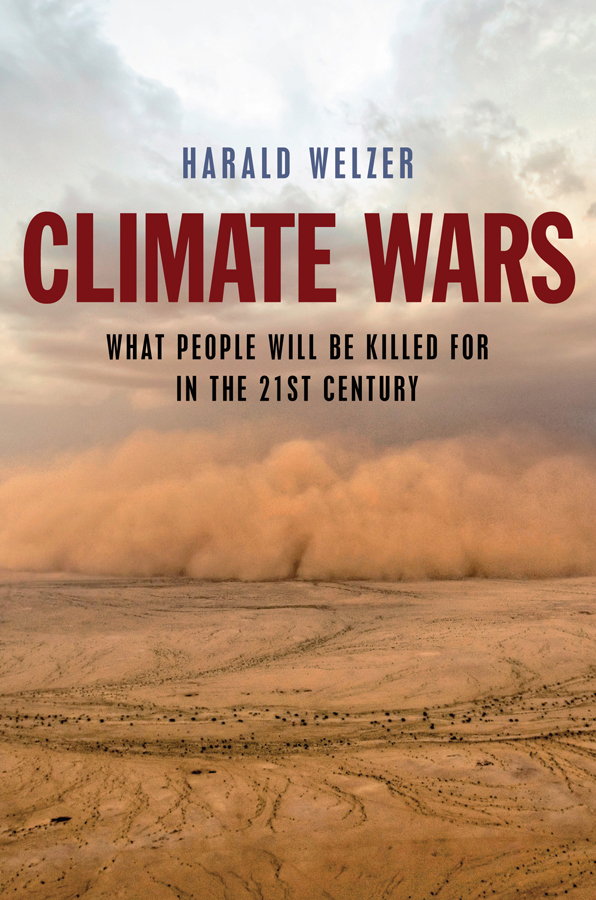
Book review: Climate Wars, Harald Welzer, 2012

Climate Wars: What People will be Killed for in the 21st Century is a book by Harald Welzer published earlier this year (May 2012) about how climate change and global warming are going to influence the future of global conflict. The reading of this book was prompted by my new research assistant position for this summer and is a fascinating read for anyone concerned with climate change, causes of violence, and global interaction and cooperation. Specifically, this is an important book for environmental science, communication, political science, international affairs, and rhetorical scholars to explore the future of human existence.


The book begins by mapping the history of violence between nations and cultures and calls specific attention to the strong and supported link between conflict and resources. When resources become scarce or at risk, violence is a natural result due to competition. This is especially true when there is perceived threat or risk, which can cause people or groups of people to become defensive, distrustful of others, paranoid, and prematurely aggressive.  Climate change has foreseeable risks and predicted damages from minor to catastrophic, so the inevitable changes that occur will likely influence communication, collaboration, and relationships between people and countries. Welzer suggests that we are already seeing the first of the "climate wars" or wars directly brought about due to changes in the environment. The genocide in Sudan, he argues, has roots in territory disputes and resulting competition for food and resources due to the lack of farmland. Changes in rainfall and weather patterns created these tension that finally culminated in violence.

Current scientific research supports Welzer's claim that climate change is inevitable and highly consequential for the world's population.

His claims to climate change specifically resulting in violence and war has been echoed by national security offices in the United States as early as the Reagan administration. For nearly thirty years, climate change has appeared in national security documents as a part (and in recent years, increasingly important part) of defense strategy and national security.

For example, many military bases and strategic operations are in open water or on coastlines. With melting ice caps and changes in rainfall patterns, there is consensus in the scientific community that sea levels will rise, endangering these operations and bases. Outside of the United States, these documents often point out the limited infrastructure of developing countries and the instability of political regimes in the Middle East as points of concern. If the United States is to continue its reign as world hegemon, there will most likely be larger burdens and strains on defense capabilities, troops, and resources as disorder is more likely to occur in other parts of the world.

One of the largest threats is migration and displacement, as people can be forced to leave their homes from a lack of resources, environmental damage, or threat of war. Massive migration will cause undue strain on neighboring areas and force military and governmental intervention. Without preparation now, there will be serious consequences in terms of political, social, and security instability on a global scale.

This book is an engaging and must-read for those interested in climate change and wish to look into the future of what damages may result from it. In an upcoming post, I will discuss further the implications of climate change for social security, and steps that are already being taken on the local level to combat the inevitable ramifications of climate change.