These are questions that guide my research and I believe they are important for all researchers and communication scholars. Feel free to add questions in the comments and debate the value of these questions. Within my interests in politics, policy formation, and the negotiation of power, I try to consider:
General Research Questions
What is my object or artifact of inquiry?
Is this artifact "interesting" or valuable to the academic community?
What questions operationalize and analyze my artifact?
How do I answer these questions?
Whose shoulders can I stand on?
Topic Specific Questions
Why do people believe some things over others?
What influences information consumption?
How are people accessing and processing information and data?
What are the effects of technology on social, political, and cultural activities?
Who has power, how did they obtain it, and how do they use it?
Who are the privileged/marginalized voices and what do they say?
What elements of speeches, advertisements, images, and narratives make them persuasive?
Past research of my has focused on the difficulties in defining values and applying them to different scenarios. Despite the research complications, values remain an important aspects of politics, religion, culture, organizations, and relationships. My recent readings of the God Strategy and the Faith Factor have reinforced my respect for the "values voters" that make up the religious right and conservatively 1/3 of the US electorate. As a united front, they are an invaluable voting block for Republicans. They typically do not vote Democratic (though recently ethnic evangelicals have for Obama) and are concerned with electing Republican nominees who reflect their values of hetero-normative definitions of marriage, anti-women's choice towards pregnancy and birth control, and a general aversion to stem cell research. The marrying of religion and politics allows for values to remain integral aspects of candidate character and personality.
Cartoon from Times-Picayune
As mentioned before, this focus on values is pervasive for all of all politics, but is especially important for Republicans. As the Grand Old Party, associated with nostalgia, antiquity, and maintaining the status quo, their candidates must embody those values more than the Democratic Party. Democrats, instead, often emphasize abstract goals for future engagement, inclusivity, and are the pioneers in equality and acceptance of minority groups (e.g., the current fight for LGBTQ rights). What has changed in recent years, however, is the polarization of these values into groups that cannot compromise on basic ideas. There is less freedom to express moderate values and politicians are in near constant campaigns. For example, the environment has become a haven for political isolation where Democrats are expected to be environmentally conscious and Republicans who are can be considered traitors. The Republican values of free market and enterprise trump those of the environment, and that is avoiding the larger issue of religious identification that also complicates the issue.
The graph above is from the Pew Research Center American Values Survey that shows the gap between support for the values. The environment has increased dramatically from only a 5% difference in those that support in 1987 to a 39% difference in those that support the environment in 2012. This polarization shows more established party lines on values where compromise is precluded by trying to remain party loyal. What is the future of American politics? How can the polarization continue with politicians and the general public operating as enemies? The 2008 election brought about massive celebrations for Barack Obama's election and massive despair from people convinced that a terrible decision had been made. Similarly, Obama's reelection was met by rumors of secession and outrage by Republicans. Perhaps my favorite response was the emerge of "White People Mourning Romney" tumblr which emerged out of whites being the only race that Romney earned the majority of their votes. South Park's rendition of the hyperbolic reactions that people had in their episode "About Last Night" perfectly sums up the political polarization currently plaguing America.
I would like to be optimistic and predict a reverse in the polarization or at least a breaking point where the polarization is no longer sustainable, but it is unlikely. I do find hope in the small compromises, but they are few and far between. One solution could be a more critical, "unlovable" media that encourages compromise by expressing the dysfunction of current polarization. The Internet can also serve as a new public sphere where citizens can serve as fact-checkers and critical observers to the political process. In the future, the polarization might decrease or change, but for now, politicians seem to be more concerned with maintaining their seats than reaching across the aisle.
Recently I read Stephen Toulmin's "Tyranny of Principles," an article written in 1981, but one I found highly relevant to current times. Toulmin, perhaps most famous for his Toulmin Model of Argumentation, describes the evolution of rules and laws from traditional discretionary practices in Roman times. I found this piece fascinating because it helps contextualize a common point of controversy in modern judicial and moral arguments, and also because I find rhetoric's roots in the judicial system and its constant tension with "ethics" (the good man speaking well) worthy of discussion.
Toulmin begins the article by describing previous methods of judiciary practices, where there were no written laws or precedents in Rome for judges to base decisions. Instead, each individual case was handled as a separate, distinct scenario in which all mitigating or unique circumstances were taken into consideration. People trusted the knowledge and discretion of the pontiffs, not an overarching law. But, as Toulmin describes, multiple factors (including immigration that changed societal norms and a need for more and thus less trained judges) constructed a need for established and referable rules which today are the basis for Western judicial systems. This transition is truly a double-edged sword, for now equality and consistency have been established, but in its stead, we sacrifice equity. Simply consider Jean Valjean in Hugo's Les Misérables, who served 19 years (5 for the crime and 14 additional for trying to escape) for
stealing bread to feed his nephew. Did he steal? Yes. Was this crime worthy of 5 years in jail? To Javert, a servant of God and the Law, there are no mitigating circumstances, a crime is a crime. And even when the tables turn and Valjean lets Javert escape, Javert is still bent on returning Valjean to jail. He eventually experiences a mental break where he cannot justify living in a world where people like Valjean violate his standards of right and wrong.
Philip Quast: Javert's Suicide
The transformation of the judicial system, our reliance on the Constitution and precedent has emphasized the letter over the spirit of the law, removed wiggle room, and devalued mitigating circumstances. One need only consider the death of Savita Halappanavar, who died from birth complications after the abortion she requested was denied. The religious (and in this case Catholic) view of abortion as wholly wrong contributed to Savita's death, whose health was not a justification for the abortion. Many anti-choice advocates do allow for abortion in cases of rape, incest, or the health of the mother, but there are prominent American politicians and even doctors that do not. In response to Savita's death, Irish politicians are attempting to re-legislate the rules concerning abortions and when the health of the mother overrides the abortion ban. As Toulmin argues, society must be wary of an over-reliance on these rules, and must refrain from adjusting laws with more laws, instead of addressing the morality and ethics of the original law.
Toulmin's article is a useful transition for me to discuss inherent discrimination and a lack of equity in
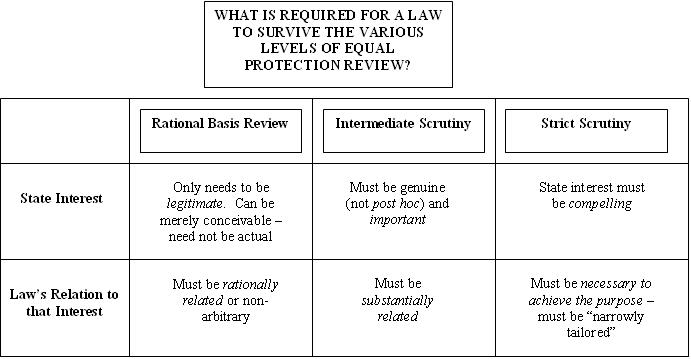
the judicial system that I learned about in a fall class. We discussed the different levels of scrutiny that the courts in America give to different types of discriminatory laws under the equal protection clause. For example, the strictest level of scrutiny is given to laws based on race and national origin, which is a prominent reason why many affirmative action cases lose when brought to court, because they treat people of different races differently. This fact, though in part justified through previous discriminatory measures that make affirmative action necessary, are not mitigating circumstances. The only way for racial discrimination of any kind to be allowed through governmental approval is if there is a "compelling state interest" and the discrimination is the most efficient way to address that interest. A famous example of this is the Japanese Internment Camps that were ruled constitutional since they did address American fears over Japanese immigrants during World War II.
Under strict scrutiny is intermediate scrutiny, for cases of gender discrimination. Under that is rational basis review, where discrimination cases based on sexual orientation or mental health are decided. I find it quite ironic that such levels exist at all. Why are different forms of discrimination created into a hierarchy of discrimination? Isn't this organization in and of itself discriminatory? It seems to me quite hypocritical and unjust for someone to receive different punishments or court ruling simply because they are a different type of bigot than someone else. I find these different strands inextricably linked. How deeply and strongly do we rely on rules of law, and for example, these seemingly hypocritical rules, when they lead to death and discrimination? Toulmin argued that we as a society should not mistake equality for equity, be satisfied with unjust laws, and tie our morality unquestionably to the rule of law. "We need to recognize that a morality based entirely on general rules and principles is tyrannical and dis-proportioned, and that only those who make equitable allowances for subtle individual differences have a proper feeling for the deeper demand of ethics" (p. 107 in Foss's Readings in Contemporary Rhetoric). I would hope that people would learn to be open-minded towards people's circumstances, take into account circumstances and mitigation, and let ourselves be human, reasonable, and overcome our obsession with perfection, black/white dichotomies, and absolutism.