Wednesday, February 27, 2013

God the Mother: Femininity and the Bible

On USC's campus in the past fall, I was approached by a woman as I was walking home from class. Thinking that she might be looking for directions, I was surprised when she approached me and asked if I had  heard of "God the Mother". I hadn't; of course I had heard of God the Father, the traditional Judeo-Christian  appositive for a higher power. I was intrigued and asked her to tell me more. This facet of Christianity follows a path of divinity for a character they call "the mother". She is described in Revelation and also in Galatians as Christ's "bride" and the "mother" of all humans. When Christ returns in his second coming, the World Mission Society Church of God believe that both female and male forms will come to rule.

Upon first hearing, these ideas sounded unique and ground-breaking to me. A larger, more prominent role for women? To be considered divine and worshiped  playing a role (as opposed to the passive Virgin Mary role) in human salvation? It seemed a positive and reassuring step in the right direction for gender equality in faith. The patriarchal system in Christianity is undeniably exclusive to females. Although some facets do allow for women to be ordained and serve in higher roles, typically faiths that believe in consubstantiation do not allow for female priests as the priest becomes Christ momentarily during the transformation of the bread to the body of Christ. Furthermore, many biblical passages undermine the role of women and encourage subordination. For example, 1 Timothy 2:12 reads, "I do not permit a woman to teach or to exercise authority over a man; rather, she is to remain quiet". Titus 2:5 describes that women should "be self-controlled and pure, to be busy at home, to be kind, and to be subject to their husbands, so that no one will malign the word of God". This is of course excluding the many passages that discuss women as property or commodities to exchange. This hierarchy of the male over the female has been reinforced or at least continued through faith (and also science, see Ferngren's Science and Religion), so I thought that this group might be an interesting foil to traditional interpretations.

I agreed to attend weekly meetings with a missionary on campus and learn more about the faith. Fascinated, I took many notes on our meetings. I quickly found, though, that this church was not as different in their treatment as I initially thought. Learning about the "God the Mother" figure reinforced for me that this was merely a different manifestation of the already sexist female role in Christianity. Similar to the role of the Virgin Mary, as I briefly described above, the Heavenly Mother emerges as a vessel, place holder, and masculine foil, with no power, characteristics, or importance herself. Instead, the Heavenly Mother incorporates the traditional gender roles of femininity (i.e., bride, spouse, mother) into a divine form. Though it may seem encouraging to have a female face among the divine, her role as a foil to Christ removes any autonomy and importance in her narrative role. To maintain narrative fidelity (as proposed by Fisher's narrative paradigm), the patriarch must still be in place and the hero of the story must remain the male protagonist. The Heavenly Mother does not challenge this role, become a hero or protagonist herself, but merely complements the masculine figure.
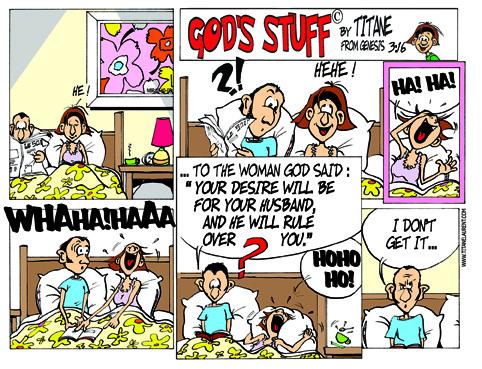
From Godstuffcartoons.com

The Heavenly Mother, and consequentially, all women, are also only laded, valued, or given importance when they fulfill their gender roles. The Heavenly Mother does not have a name, like Christ, or a purpose, other than to serve Christ and be the mother of all humans. The Heavenly Mother thus becomes nothing more than the Virgin Mary: a divine vagina. Her sexual organs are the only meaning she provides for the narrative, as a sexual object for Christ as bride and a vessel for human life as mother. The woman I met with emphasized the importance of the family structure, the "nuclear" mother, father, children unit that is the backbone of society. This structure is a metaphor for the larger Father, Mother, and humankind as children. After prompting by me, my faith partner also admitted that the LGBTQ community does not fit this holy female-male binary (transfemales not in possession of the normative sexual organs) so should be banned from marriage.

My hopes for a more inclusive, engaging, and female-friendly version of Christianity were definitely dashed. I see no benefit to having a divine female figure if her only contribution to the faith is her vagina and its function. I continued to meet with the conversation partner for a few weeks, learning about why her faith was the "true" faith and the literal word of the Bible and its importance. Not only does this faith believe in the second coming, but they believe it will happen in our lifetime. During that apocalypse, we will be welcomed by both Christ and his bride, to be reunited as a heteronormative, nuclear family.

Wednesday, February 20, 2013

The Best of Larry List

After not checking my mail.com account for a few months, I was shocked to find over 3000 emails from Dr. Larry Gross as a subscriber to his infamous "Larry List". These emails are all fascinating and interesting articles that Dr. Gross shares to this email list and can number in the dozens per day. Going through them all finally, I wanted to share my favorite articles. There is really no rhyme or reason to them besides that I found them interesting. Enjoy!


Atmosphere of Distortion
This article discusses the relationship between climate change and daily temperatures. Though climate change  is reflective of long term changes and patterns, skeptics often point to snow and cold weather as arguments against climate change.


DOLLY Data
This map represents aggregated Twitter data on the presence of "beer" (blue) and "church" (red) by frequency and quantity. This is an interesting use of Twitter which echoes my involvement with the Twitter sentiment project at the Annenberg Innovation Lab. Twitter is still a new arena for communication scholars, so I find these endeavors into how to operationalize the data fascinating.


Infinity
This article interests me because of the interesting connection math has between sciences and humanities. Theoretical math has inextricable ties to both physics and philosophy, which this article explores. Especially when one thinks about why we are here, where did we come from, and how do things function, areas such as physics, communication, religion, mathematics, and philosophy all find space to explore the answers.


Sky Monsters
These images are not interesting from a research perspective, but simply because they are beautiful representations of what might otherwise be a normal storm cloud.


Movies in Miniatures
This portfolio of pictures represents (as the artist describes) an intersection between Eastern art with Western film. My interests in narrative make these photographs interesting. Without captioning or explaining, viewers can instantly recognize the scene and thus, the film that the pictures are representatives and icons of the narratives themselves. Despite the difference in style and presentation, the image above is instantly recognizable as the scene from Alien where the creature emerges from the character's chest.


Singapore Airport Art
There have been many attempts at airport art, as a distraction from the banality of airport travel and inevitable delays and lost baggage. This one might be the most successful. It is reminiscent of a lava lamp, with its simple shapes and movements, but hypnotizing and enticing.

Prius Features
This video is just hilarious. The irony in adopting environmentally friendly policies is that you can never truly offset the carbon one produces from being alive. Massive deaths (a la Soylent Green) could be advocated for on behalf of the environment. Funny and philosophical, the perfect Onion piece.


*Images retrieved from websites listed

Wednesday, February 13, 2013

The Appeal of Horror

Although I've always known that my preference for horror films over romantic comedies draws curiosity and concern from others, I never understood why. What is it about horror films that makes my interest in Saw, Hostel, and The Cabin in the Woods inherently worse than in No Strings Attached, The Notebook, or Sweet Home Alabama?

This is not an avenue of research I would pursue with any intensity, but its frequent occurrence in my life makes it a perfect blog post entry. Below are some musings and thoughts I've had about why horror is offensive on a basic level to human nature and why some yearn for that experience in the theater.


One of the issues in horror films is their defiance and utilization of reality. Whereas science fiction and fantasy is inherently "unbelievable", romantic comedies are life-like and true to reality. Outside of the necessary fantasy of Hollywood, unique plot points, and unlikelihood that come with a film, there is a transcendence that occurs naturally with romance, comedies, and dramas. Real people being dealt unlikely, but possible events, with real emotion and reaction. For the most part, these films follow standard structures with the protagonist achieving their goal or the couple uniting in the end. Aberrations from this structure may serve as a twist to surprise the audience, but the structure remains mostly intact.

Horror changes this structure by combining the reality of dramas, comedies, and romance with the abnormal and occult of science fiction and fantasy. Just as Harry Potter takes the reality of a rough childhood and transforms it into magical fantasy, horror films take the reality of normal, everyday people and sends them directly to Hell. The Saw films punish people for taking life for granted, something that everyone can be considered guilty of. The Hostel films torture people on vacation based on random acquisition. The reality of people's stories create an affinity and connection between the audience and the characters, allowing for a dangerous and frightening transcendence. Connecting with characters about to undergo bodily, mental, and psychological damage and harm can be an uncomfortable position for the average movie-goer.

People are willing to go and see them, however. The same adrenaline rush that brings people to amusement parks for a roller coaster ride fills the seats at the midnight premiere of the 7th Saw movie. The fear that arises from the films might be in the loss of power. Denying the basic, happy-ending structure of other films, horror movies remove the viewer from a position of power: from knowledge and expectations. Horror villains may have no explanation, attacks may come at any time from any location, and the fate or safety of the characters is variable. For example, the complete back story of Jigsaw, the villain in Saw, is revealed slowly and in pieces over the course of the movies, making his actions and the actions of his disciples mysterious and random. Epitomizing the random attacks is the Final Destination series, where "fate" is literally the villain that interacts with the environment around the characters to kill them in accidental ways. There is no man or monster hiding and approaching, but merely objects and spaces manipulated to attack and murder the characters at any point. Because it is a horror film, there are almost always murders or deaths, especially of the main characters. The survival of the characters (if any) usually only follows the deaths of others in the group.


The fear that these movies create is often avoided by movie-goers looking for an "escape" or pleasant experience. For those that do enjoy them, myself included, the pleasure comes from not knowing and experiencing something that is unique to movies and entertainment. The horror movie is an escape from the normal, everyday, average life, by exposing viewers to the dark side of reality.

I do not know what my favorite horror film would be, but I have to say that the recent Joss Whedon film, The Cabin in the Woods, has become a strong contender. The variety of emotions, from nervous and terrified, to intrigued and confused, to laughing out loud in the theater, this movie was the perfect horror film for me. Even for those not a fan of horror films, familiarity with the genre will help you appreciate the satire and exaggeration that makes this film an instant classic.