Wednesday, May 30, 2012

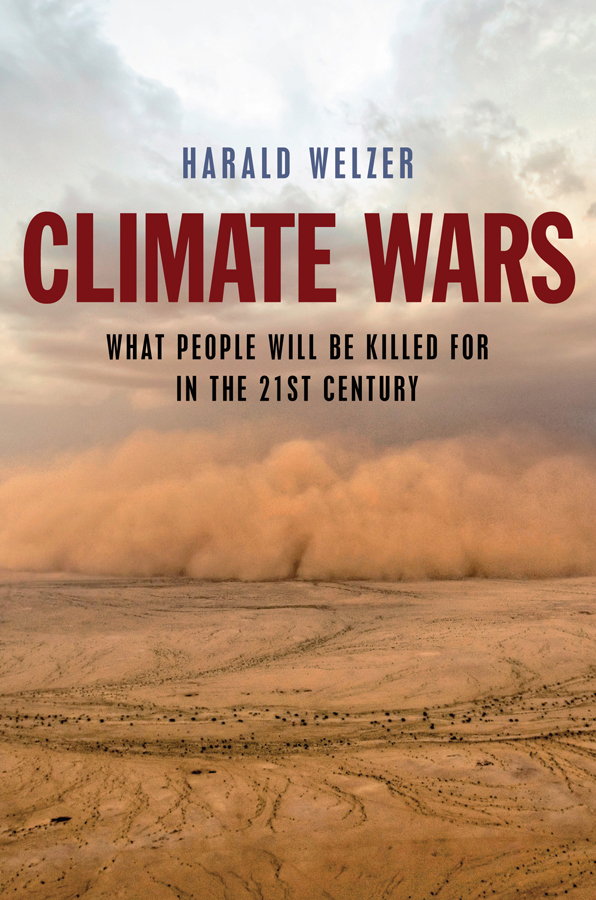
Book review: Climate Wars, Harald Welzer, 2012

Climate Wars: What People will be Killed for in the 21st Century is a book by Harald Welzer published earlier this year (May 2012) about how climate change and global warming are going to influence the future of global conflict. The reading of this book was prompted by my new research assistant position for this summer and is a fascinating read for anyone concerned with climate change, causes of violence, and global interaction and cooperation. Specifically, this is an important book for environmental science, communication, political science, international affairs, and rhetorical scholars to explore the future of human existence.


The book begins by mapping the history of violence between nations and cultures and calls specific attention to the strong and supported link between conflict and resources. When resources become scarce or at risk, violence is a natural result due to competition. This is especially true when there is perceived threat or risk, which can cause people or groups of people to become defensive, distrustful of others, paranoid, and prematurely aggressive.  Climate change has foreseeable risks and predicted damages from minor to catastrophic, so the inevitable changes that occur will likely influence communication, collaboration, and relationships between people and countries. Welzer suggests that we are already seeing the first of the "climate wars" or wars directly brought about due to changes in the environment. The genocide in Sudan, he argues, has roots in territory disputes and resulting competition for food and resources due to the lack of farmland. Changes in rainfall and weather patterns created these tension that finally culminated in violence.

Current scientific research supports Welzer's claim that climate change is inevitable and highly consequential for the world's population.

His claims to climate change specifically resulting in violence and war has been echoed by national security offices in the United States as early as the Reagan administration. For nearly thirty years, climate change has appeared in national security documents as a part (and in recent years, increasingly important part) of defense strategy and national security.

For example, many military bases and strategic operations are in open water or on coastlines. With melting ice caps and changes in rainfall patterns, there is consensus in the scientific community that sea levels will rise, endangering these operations and bases. Outside of the United States, these documents often point out the limited infrastructure of developing countries and the instability of political regimes in the Middle East as points of concern. If the United States is to continue its reign as world hegemon, there will most likely be larger burdens and strains on defense capabilities, troops, and resources as disorder is more likely to occur in other parts of the world.

One of the largest threats is migration and displacement, as people can be forced to leave their homes from a lack of resources, environmental damage, or threat of war. Massive migration will cause undue strain on neighboring areas and force military and governmental intervention. Without preparation now, there will be serious consequences in terms of political, social, and security instability on a global scale.

This book is an engaging and must-read for those interested in climate change and wish to look into the future of what damages may result from it. In an upcoming post, I will discuss further the implications of climate change for social security, and steps that are already being taken on the local level to combat the inevitable ramifications of climate change.

Tuesday, May 22, 2012

The Power of the Youth Vote in the 2012 Presidential Election

With the Republican nominee all but decided, the question has become whether Obama or Romney will be the victor in November. I've already discussed the implications of "firsts" for the 2008 and 2012 elections, but in today's post I'd like to discuss the likelihood of an Obama/Romney victory. The reason for the post was spurred by a recent infographic provided to me by Shirley Zeilinger from Best Colleges Online. It is not uncommon to argue that the youth vote was imperative to Obama's victory in 2008, particularly because they came out in such high numbers. Given that youth typically lean liberal, simply motivating youth to attend the polls (e.g., Rock the Vote efforts) are likely to tip voting in the favor of the Democrats. The info-graphic outlines the demographics and past voting habits about youth voters and uses this information to predict the youth vote again going to Obama with a margin of 17 points (43% to 26%).

The infographic is fascinating and I would recommend reading it in full, but I will highlight here the most prudent parts and discuss how this margin is likely to change. The image is right to point out that though the youth still greatly favor Obama, they are not as motivated and engaged in the 2012 election. This is most likely due to the lack of energy, the urgency, and the morality behind supporting the first black president. Obama was also voted in under a large pretense that he would be able to provide a much sought after change from the leadership of Bush. Failing to meet those expectations, however impossible, may leave a sour taste in the mouths of some voters who feel abandoned, tricked, or disheartened. This could restrict a willingness to vote at all or lead to a changed vote for the Republicans.

Though it is cliche, I feel that the expression "better the devil you know than the devil you don't" does have its applications in politics. As of now, Obama is the only candidate with a united front behind him, a presidential track record, and some political successes that can inspire voters. Romney, on the other hand, is not only still a contested nominee, but is trying wholeheartedly to separate his current platform from his experience as governor of Massachusetts. During his time as governor, his more conservative opinions on topics (e.g., health care, abortion, gay marriage) were compromised in the liberal state. Without this track record and without the unified front from Republicans, Romney is starting out far behind Obama in this election. This is also not to mention his association with the Church of Jesus Christ of Latter-day Saints (for a more in-depth discussion, see this post). Capitalizing on the already increased skepticism of politicians, Romney is an unlikely choice for first-time or second-time voters.

What might be a change in the tide for Romney, though, is the approaching Republican National Convention that will explicitly label him the nominee. That support will quell detractors from the Republican party and help start Romney's journey to being treated like a candidate by his fellow party members. Creating a unified front at the end of August, though, leaves Romney little more than two months to capitalize on his nomination. Until then, efforts to attack Romney may continue, and attacks against Obama will continue from multiple hopefuls. After August, though, Romney may garner a more coherent party narrative that is more convincing to the youth than the arguably failed one of "hope" and "change" from Obama.

The power of the youth vote, then, will tip in Obama's favor, but will it ultimately be enough to give him the victory? Only if they come out in as high numbers in 2008, and that is doubtful. They are probably Obama's most important voting group, but I doubt that any marketing techniques can revive the political spirit that was awakened in many youth in 2008. Although the best indicator of future political behavior is past behavior, the infographic also reports that less than half (46%) of youth voters polled are planning on voting in 2012. Without the motivated swarms of youth voters to support him, Obama may be up for a much bigger challenge in 2012 than in 2008.

Thursday, May 17, 2012

Article Review: Rhetorical Criticism of the 2008 Election, Bloomfield & Katula, 2012

At risk of being self-serving, this week I am reviewing an article that I wrote at my undergraduate university, Northeastern. My reasoning for this is that I will be presenting it at the International Communication Association conference next week in Phoenix, and I believe that walking through the piece with specific attention to limitations and implications will help prepare me. Feedback and comments are always welcome, but on this post in particular.

The purpose of the study was to evaluate the use of values in presidential announcement speeches. Using the three front-runners from the Republican and Democratic parties in 2008, the types of values and their frequencies were coded for compliance with value theory. Perelman & Olbrechts-Tyteca (1969) outline 5 ways to begin the process of persuasion, named the "premises of agreement". They proposed that values are one of these premises and that values can be split into concrete and abstract categories that correspond with conservative and liberal ideologies, respectively. Matching these ideologies with their current political label, researchers created a list of abstract and concrete values (based off of public opinion polls) to see if politicians were using the "correct" values. Assuming that values are more successful in creating agreement with those of the same ideology, the politicians that are most successful in doing this may see the most success in the campaign.

Using Trent and Friedenberg's 1978 evaluation of announcement speeches as "telescopic" of the campaign, the announcement speech was coded for each candidate. The results showed that Obama, Edwards, and Paul were the only candidates that used a specific type of value more than another, with Obama being the only one that used the "correct" type of value more. McCain, Clinton, and Romney showed no statistically significant preference for either value (alpha level = .05). Paul used significantly more abstract values (liberal) than concrete values (conservative) and Edwards preferred the opposite. Obama significantly favored abstract values, which according to Perelman and Olbrechts-Tyteca are associated with the liberal ideology, which is his own party affiliation, p = .02.

This results have important implications for how candidates are structuring their campaigns to appeal to voters and creates a quantitative measure for a rhetorical technique and its success.

There are important limitations to the study, which are outlined further in the paper, but will be listed here:

  • coding of the speech was done in an "inauthentic" environment
    • speech was read, not heard
  • there are many factors that determine presidencies, so the narrowing of success to one variable is impossible
    • though determining factors and their influence is important for scholars of political rhetoric and communication
  • only coded one speech of the campaign instead of a sampling of multiple speeches
  • creating a completely inclusive list of values is probably impossible, so this study may be missing other important values that would be influential in forming agreement
This article is to be presented at ICA in its current form and I am happy that another project (about the difficulty in coding for values) is in progress due to this study.