Sunday, March 16, 2014

Thin Privilege and LGBTQ Issues: Discrimination based on Choice

There has been a recent surge in websites, blogs, and tumblrs that deal with "Thin Privilege." These sites have also spawned spoof or parody sites  which have in turn encouraged reaction sites. In the back-and-forth on these websites that I have followed, I would like to comment on a common theme which I think connects issues of health and bodies to the LGBTQ community: choice. First, I will explain these communities then I will draw from examples from each and compare them through Burke's pentad as revolving around agency and choice.

Retrieved from this blog
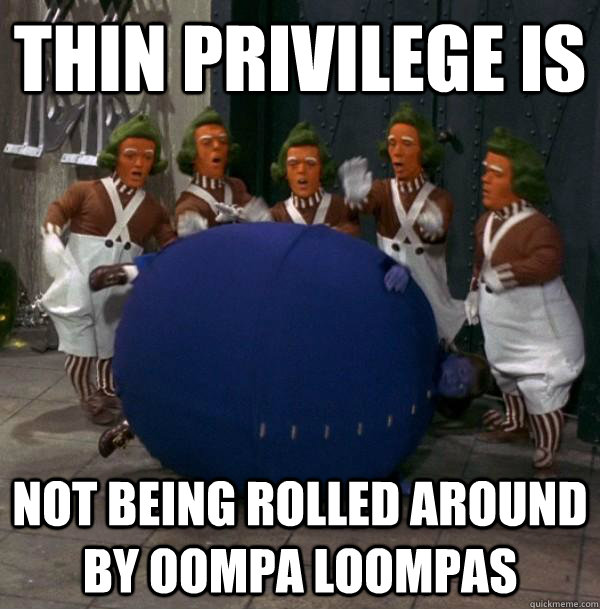
Thin Privilege reflects the advantages and benefits that come with being thin (or non-fat) in a society that values skinny bodies over large bodies. This has resulted in cultural and institutionally prejudices levied at non-thin people. Thisisthinprivilege.tumblr.com is dedicated to individuals sharing their personal stories of discrimination because of their size. Key themes are the idea that being large in body is associated with unhealthiness (which they argue is not necessarily true), being impacted by a lack of services available to them (such as the size of airplane seats), lacking role models in media, and experiencing fat stigma (e.g., strangers trying to give diet advice or calling names). The stories range from not being able to find clothing sizes in stores to having doctors ignore potential health issues because weight was a perceived larger concern. This site often posts "troll" questions and comments and critiques them as coming from a place of privilege or purposefully trying to undermine their cause. The key take-away from this site is that no one with privilege can deny others their claim to discrimination, police their language, or undermine their cause.

Retrieved from this blog as an example of skewed expectations and a world made for unrealistic body sizes.
From comments on these webpages, I found immense similarities to discussions of LGBTQ rights. The similarities center around the idea of choice. If one believes that being fat or being LGBTQ is a choice, they are more likely to be negative, critical, and dismissive of societal backlash that occurs for them. If one believes that these identifications happen naturally or are a product of the environment (e.g., hereditary/genetic), then one is more sympathetic to the effects experienced. This proclivity to blame the individual (agent) or the environment (scene) can be mapped onto Burke's pentad. The pentad is a tool that critic's can use to analyze situations in terms of its agent, agency, purpose, scene, and act. If the act performed is discrimination against someone, emphasizing the agent may cause one to believe that the recipient caused it themselves. Emphasizing the scene, however, may cause one to believe that society fosters discriminatory attitudes against minority communities. Papers I've been working on, influenced strongly by papers by Brock (1990), argue that these can be directly related to political ideology. Republicans may be more likely to consider the agent responsible (e.g., pull one up by one's bootstraps) and Democrats may be more likely to consider extenuating circumstances (e.g., how scenic factors influence one's actions and treatment).

Retrieved from this site
To consider a large person and a gay person autonomous agents that make choices about their identity is to remove environmental and societal factors from responsibility. This type of view undermines the culpability of institutions and those with normative privilege (e.g., thin and hetero-) for discrimination. Somehow, making a choice to do something as opposed to having it happen to you, makes one more deserving of disdain and scorn. Those who had no choice can be viewed as vulnerable, victims, and innocent. Analyzing these situations as similar help us to connect issues of discrimination and shared experiences of minorities against ableist/cis/hetero/white/male society. From within that community, it is hard to assign oneself culpability and guilt; people would rather blame the individual than admit shared responsibility for discrimination. Just as people were quick to yell "post-race!" with the election of Obama, people are quick to jump to answers that do not include our own or systemic faults.

Retrieved from this site to represent the traditional Barbie size to the new "real proportions" doll

How does society move beyond discrimination? I think it's important for those of us with privilege is to step back and truly listen to the words of those without privilege or those at the intersections. We cannot understand the discrimination not having been privy to it. Trying to deny the stories of others or to argue with our own stories of discrimination only perpetuates structural inequalities. Just consider the backlash that happened when a new Barbie copy with "realistic proportions" came out that would encourage girls to idolize being unhealthy. Instead, why can we not consider these positive steps to creating a more inclusive culture that teaches people to love and respect their own bodies, no matter its size? ThisisThinPrivilege.tumblr.com is fighting against other blogs and the system that devalues fat bodies. Though this article is not meant to be evaluative, it cannot help but reach the conclusion that to reduce people's identities to arbitrary choices is to undermine the perpetual problem of discrimination. As posted on the website, people are fighting a system that "systematically reduces each of us to our dress size, hip measurement, and waist size, then grants favors, opportunities, or simple lack of punishment when the numbers are low enough" and instead fights for a system that treats everyone as equally human.

Sunday, March 9, 2014

Energy Darwinism: Substituting Economic Benefits with Moral Imperatives

Concerns over climate change has pushed the delicate relationship between short term benefits and long term risks and economic and environmental balance. Recent reports published by Citi (and subsequent national commentary on them) have focused on the idea of "Energy Darwinism." In this post, I hope to explicate this term, relate it to evolution and natural selection as the metaphor implies, and what this says about moral and religious obligations to the environment. 


Retrieved from this blog
As a brief point of introduction, natural selection, or "Darwinism" is the basic mechanism of evolution. From the assemblage of single-celled organisms to humanity, genetic variations accumulate over time and create branches of descendants and all of the life on earth today. The basic tenets of natural selection is that mutations occur in DNA to produce variations which are then competitively selected by the environment, mating preferences, and predator/prey relationships. Interpretations of evolution often forgo the opportunity for supernatural or divine intervention, making it a materialist theory of origins. Thus, evolutionary theory has often been opposed by religious adherents who regard it as immoral and too largely focused on the environment as a guiding force. Alternative narratives often find a role for a deity such as creationism or intelligent design. Labeling evolution "Darwinism" is in part a rhetorical strategy to reduce the explanatory power of evolution to the worship of an individual.


Retrieved from this blog
Although natural selection was not meant to be applied to other areas of life, especially not human life, many people have demonized the competitive spirit of natural selection as damaging to humanity. Social Darwinism is an attempt to label philosophies of human competition with evolutionary characteristics. Energy Darwinism is a new application of evolutionary theories to industry reactions to environmental protection. The concept refers to the economic benefits of businesses becoming more eco-friendly. As carbon becomes more expensive as demand remains (or increases) and supply decreases, businesses themselves will move towards alternative sources in order to remain competitive. There is an irony in professing that Darwinism, which is often levied as a negative descriptor of human competition, aggression, and exploitation is used as industry competition that may drive down prices, encourage innovation for selfish needs for profit/money. Energy Darwinism may seem a simple, logical concept, but there are sinister implications and consequences for such thinking.

If the changing economic environment will change naturally to encourage better business practices, this removes the responsibility of industry to be purposeful actors and the government from intervening in environmental protection. There would be no need for regulations, national laws, and international agreements about reducing carbon and encouraging change because industries will naturally adjust to environmental pressures. Industries are reduced to the world of motion (such as the basic functions of animals), incapable of rational and symbolic action (such as the functioning of humans) that would require thoughtful reflection and intervention. Furthermore, the discussion of environmental protection is reduced to economic benefits, arguably the reason why the environment has been harmed to such extent. Energy Darwinism removes economic structures from culpability and instead worships it as the source of salvation. The system will correct itself, so there is no need for activism or change.


Retrieved from this blog
A better motivation for environmental protection perhaps lies in moral arguments instead of economic ones. Though Energy Darwinism provides hope that businesses might be motivated to act, economic motivations are certainly questionable for immediate actions. Especially considering the Key Stone Pipeline and other important changes happening now, it seems that waiting for industries to succumb to pressures in the economic system will be too little, too late. Religious arguments, however, often propose moral obligations to protect the Earth for future generations and appeals to charity to help those in less developed countries accommodate environmental change. These arguments are certainly more appealing on a basic level of caring for fellow humanity, but it is perhaps overly optimistic to think that these arguments might ever have the persuasive power of dollar signs. 

Tuesday, March 4, 2014

Academic Labor and Producing the Graduate Student

Now half-way through my 5-year program at USC, I have experienced a lot of pressure from the "publish or perish" graduate mindset. In short, I am making no big claims to state that graduate school is about producing research and work, whether in class, through conferences, or in journals. The need to be constantly producing becomes an expectation. Admitting that I did not get into a conference (which we are competitive and selective) elicited, "what do we pay you for?" as a response. People are always concerned with who is publishing where and how frequently and which conferences have deadlines coming up. One's success in performing academic labor is measured by output or the products made. The two papers I entered in that conference that are now works in progress do not "count" until they have been officially recognized at a conference or journal. Un-submitted ideas are never seen, never appreciated, never counted towards tenure. This post is not meant to be a eulogy for all of my un-works, but simply a lead-in to my larger discussion of what it means to produce academic labor.

Retrieved from PhD Comics

As a graduate student, faculty, or staff member at a university, there are constant measurements and metrics in place to ensure one is meeting the unspoken yet pervasive standards of constant productivity. In producing this labor, are we not falling into the trap of capitalism as warned by Marx? Are we not separated from the fruits of our production? Scholars may feel forced or compelled to produce quantity over quality, experiencing distance and separation from their work in an attempt to meet production standards. It is hard to reach the journal-level quality of work when we are constantly being asked to produce paper after paper for classes, conferences, grants, and outside projects. Our salary is fixed, yet we may work extra hours (if one can say the clock is ever off) without compensation. Though we may rise in the ranks to post-doc, clinical faculty, or tenure track faculty, we never fully emerge from the pressures of a proletariat lifestyle that conditions us in the ideology of produce, produce, produce. This is not to undermine the system or call anyone to blame, but simply to reflect on the structure that informs our actions, why it does so, and if can it be changed. If we mean to highlight quality over quantity, how does publish or perish help us get there?

Retrieved from Saturday Morning Breakfast Cereal

The pressure to be thinking, writing, and producing in part encouraged the creation of this blog. This motivation, coupled with my inability to produce journal-quality writings on all the topics I may want to comment on, encourages me to constantly update and consider life in an academic mindset. What is the value of this productive labor? For some, it may be monetary. Google Ads can be placed on Blogger and other Google hosted sites that provide the author a few cents per "click" on the ads placed within the site. I've also received emails about this blog asking me to write up posts about certain products and sell a permanent ad space that I would reference sporadically in my posts. Despite the fact that this is a research blog, not a consumer blog, they offered me $125 for the initial advertisement and $50 for every subsequent reference. This is the example blog post they asked me to use as a template. At first, I was surprised that my random musings on religion, the environment, and culture could be deserving of actual monetary compensation. Or, had I merely been trained by my other graduate work to consider my research a non-monetary exchange value? Although I am not sure what the value is of the words on this blog, I can say that the reputation I am building as a scholar is worth more than the few hundred dollars I would get from advertising for cars on my research blog. I suppose, there is some type of intangible productive value that I do retain from my work, only to be cashed in a few more years down the line, for a higher salary and job security. Until then, the alienation and potentially damaging stress appears to just be part of the process.