Sunday, February 2, 2014

The Dangers of Pervasive Skepticism: Creationism, Anti-Vaccines, and Climate Deniers

A recent LA Times op-ed by Pat Morrison addressed importance similarities between science-deniers that affect more people than just believers. Creationists and anti-vaccine advocates affect the collective intellectual and physical health of those around them due to their rejection of scientific evidence. Though this is an important point, it only scrapes the surface of larger issues surrounding pervasive skepticism and the borrowing of scientific authority.

In associating science with faith, deniers of current scientific knowledge present themselves as "true" science. These groups portray themselves as fighting against hegemonic elites that wish to silence minority opposition. Anti-vaxxers claim the right to abstain, equating scientific practice with replacing parental control. Creationists point to gaps in scientific research and claim that science requires a greater leap of faith than religious explanations.

Retrieved from Ape, Not Monkey

 By appealing to scientific standards of skepticism, re-testing, and a progressive search for knowledge, science-deniers can pose as legitimate scientific inquiry. Creationists use this platform to enter science textbooks, school boards, and even university faculty. Anti-vaxxers use this platform to flood public spaces with literature, websites, and non-profits.

Other skeptical groups, such as climate deniers, also appeal to “scientific” facts and gaps in evidence to forestall legislative action. Democratic Senator (CA) Barbara Boxer held a committee about the President’s Action Plan that was met with much controversy over Dr. Judith Curry’s testimony. In this testimony, Dr. Curry misrepresented Intergovernmental Panel on Climate Change’s reports on current scientific evidence and cherry-picked statements of uncertainty about current predictions.

Morrison’s original comparison begins to uncover this larger, pervasive issue of skepticism that ignores scientific evidence and authority, and replaces it with a facade of scientific inquiry. The key mistake in the piece however, is the piece’s ending that states, “Ignorance is curable by education, but willfully ignoring the facts can be contagious — and even fatal.” To assume that education is the missing link between science accepters and deniers is to oversimplify the argumentative frameworks that each occupies.

Those who believe in creationism tie their beliefs to every action of their lives as a guiding force. The origin of humanity is not merely an issue of fact, but of the definition and explanation for one’s entire life. Rejecting creationism or not fighting for its inclusion in schools is viewed as a betrayal of faith and submission to the elites of science that denies alternative explanations.
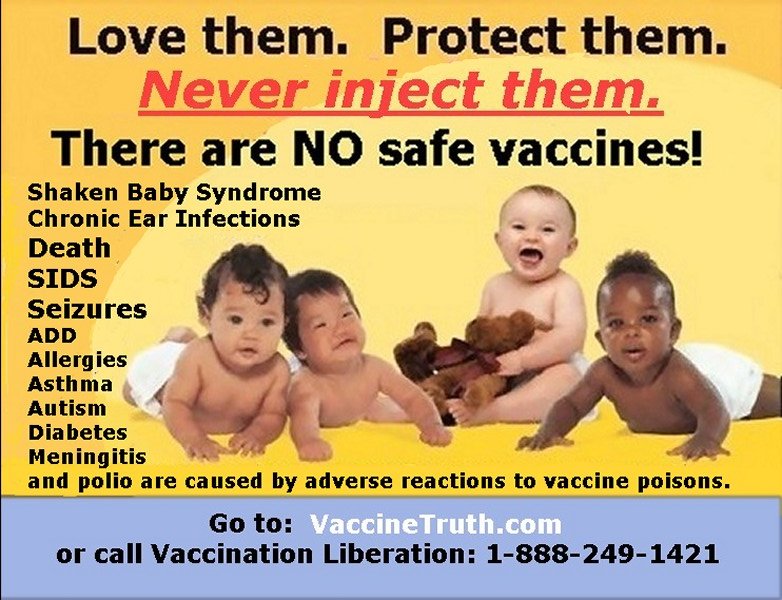
Retrieved from Vaccine Truth

 Anti-vaxxers are focused on protecting their children and the children of others, an extremely powerful motivating factor. Simply presenting new information or facts may not deter strongly held beliefs influenced by celebrity moms or one’s peers.

Those who deny climate change may find themselves more fiercely loyal to a political party or economic influences than long-term environmental protection. More science and data may fall on deaf ears, as other priorities overshadow and complicate accepting new information.

Kenneth Burke, rhetorician and scholar, wrote in Attitudes Towards History, “The shift to another attitude, requiring a different rationalization, does involve ‘conflict.’ Insofar as we do not ‘travel light,’ we thus assemble much intellectual baggage, and the attempt to reshape this to new exigencies may require considerable enterprise” (p. 184). To replace the baggage collected over one’s entire life with new, contradictory exigencies nearly requires rejection. Introducing new information or repeating old information through education is rarely enough to shift rationalizations for action and behavior.

Skeptics do not “ignore the facts;” they simply do not respect the facts lauded by scientific frameworks. Instead, they replace with their own facts such as the importance of God’s role in human origins, the autonomy of parents over children, and the benefits of short term party loyalty over long term environmental protection. The issue is not, then, ignorance, but of warring frameworks that are currently empowered by a skeptical culture to reject scientific authority. Instead, the focus should be on separating what is science and what is not, giving skeptics a voice, but not allowing that voice to be labeled scientific.

The culture of skepticism is damaging scientific enterprise and Morrison is right to point out the wide effects that skepticism has. The conclusion, however, is not to rely on education, but acknowledging alternative viewpoints while minimizing their influence.

Sunday, November 10, 2013

Important Questions for Communication Scholars

These are questions that guide my research and I believe they are important for all researchers and communication scholars. Feel free to add questions in the comments and debate the value of these questions. Within my interests in politics, policy formation, and the negotiation of power, I try to consider:

General Research Questions
What is my object or artifact of inquiry?
Is this artifact "interesting" or valuable to the academic community?
What questions operationalize and analyze my artifact?
How do I answer these questions?
Whose shoulders can I stand on?

Topic Specific Questions
Why do people believe some things over others?
What influences information consumption?
How are people accessing and processing information and data?
What are the effects of technology on social, political, and cultural activities?
Who has power, how did they obtain it, and how do they use it?
Who are the privileged/marginalized voices and what do they say?
What elements of speeches, advertisements, images, and narratives make them persuasive?
What arguments are believed and why?

Wednesday, October 23, 2013

The Importance of Values in Polarization

Past research of my has focused on the difficulties in defining values and applying them to different scenarios. Despite the research complications, values remain an important aspects of politics, religion, culture, organizations, and relationships. My recent readings of the God Strategy and the Faith Factor have reinforced my respect for the "values voters" that make up the religious right and conservatively 1/3 of the US electorate. As a united front, they are an invaluable voting block for Republicans. They typically do not vote Democratic (though recently ethnic evangelicals have for Obama) and are concerned with electing Republican nominees who reflect their values of hetero-normative definitions of marriage, anti-women's choice towards pregnancy and birth control, and a general aversion to stem cell research. The marrying of religion and politics allows for values to remain integral aspects of candidate character and personality.

Cartoon from Times-Picayune

As mentioned before, this focus on values is pervasive for all of all politics, but is especially important for Republicans. As the Grand Old Party, associated with nostalgia, antiquity, and maintaining the status quo, their candidates must embody those values more than the Democratic Party. Democrats, instead, often emphasize abstract goals for future engagement, inclusivity, and are the pioneers in equality and acceptance of minority groups (e.g., the current fight for LGBTQ rights). What has changed in recent years, however, is the polarization of these values into groups that cannot compromise on basic ideas. There is less freedom to express moderate values and politicians are in near constant campaigns. For example, the environment has become a haven for political isolation where Democrats are expected to be environmentally conscious and Republicans who are can be considered traitors. The Republican values of free market and enterprise trump those of the environment, and that is avoiding the larger issue of religious identification that also complicates the issue.


The graph above is from the Pew Research Center American Values Survey that shows the gap between support for the values. The environment has increased dramatically from only a 5% difference in those that support in 1987 to a 39% difference in those that support the environment in 2012. This polarization shows more established party lines on values where compromise is precluded by trying to remain party loyal. What is the future of American politics? How can the polarization continue with politicians and the general public operating as enemies? The 2008 election brought about massive celebrations for Barack Obama's election and massive despair from people convinced that a terrible decision had been made. Similarly, Obama's reelection was met by rumors of secession and outrage by Republicans. Perhaps my favorite response was the emerge of "White People Mourning Romney" tumblr which emerged out of whites being the only race that Romney earned the majority of their votes. South Park's rendition of the hyperbolic reactions that people had in their episode "About Last Night" perfectly sums up the political polarization currently plaguing America.


I would like to be optimistic and predict a reverse in the polarization or at least a breaking point where the polarization is no longer sustainable, but it is unlikely. I do find hope in the small compromises, but they are few and far between. One solution could be a more critical, "unlovable" media that encourages compromise by expressing the dysfunction of current polarization. The Internet can also serve as a new public sphere where citizens can serve as fact-checkers and critical observers to the political process. In the future, the polarization might decrease or change, but for now, politicians seem to be more concerned with maintaining their seats than reaching across the aisle.