Monday, September 30, 2013

Discrimination and Rhetoric in the Judiciary

Recently I read Stephen Toulmin's "Tyranny of Principles," an article written in 1981, but one I found highly relevant to current times. Toulmin, perhaps most famous for his Toulmin Model of Argumentation, describes the evolution of rules and laws from traditional discretionary practices in Roman times. I found this piece fascinating because it helps contextualize a common point of controversy in modern judicial and moral arguments, and also because I find rhetoric's roots in the judicial system and its constant tension with "ethics" (the good man speaking well) worthy of discussion.


Toulmin begins the article by describing previous methods of judiciary practices, where there were no written laws or precedents in Rome for judges to base decisions. Instead, each individual case was handled as a separate, distinct scenario in which all mitigating or unique circumstances were taken into consideration. People trusted the knowledge and discretion of the pontiffs, not an overarching law. But, as Toulmin describes, multiple factors (including immigration that changed societal norms and a need for more and thus less trained judges) constructed a need for established and referable rules which today are the basis for Western judicial systems. This transition is truly a double-edged sword, for now equality and consistency have been established, but in its stead, we sacrifice equity. Simply consider Jean Valjean in Hugo's Les Misérables, who served 19 years (5 for the crime and 14 additional for trying to escape) for 

stealing bread to feed his nephew. Did he steal? Yes. Was this crime worthy of 5 years in jail? 
To Javert, a servant of God and the Law, there are no mitigating circumstances, a crime is a crime. 
And even when the tables turn and Valjean lets Javert escape, Javert is still bent on returning 
Valjean to jail. He eventually experiences a mental break where he cannot justify living in a world 
where people like Valjean violate his standards of right and wrong.


Philip Quast: Javert's Suicide

The transformation of the judicial system, our reliance on the Constitution and precedent has 
emphasized the letter over the spirit of the law, removed wiggle room, and devalued mitigating 
circumstances. One need only consider the death of Savita Halappanavar, who died from birth 
complications after the abortion she requested was denied. The religious (and in this case Catholic) 
view of abortion as wholly wrong contributed to Savita's death, whose health was not a justification 
for the abortion. Many anti-choice advocates do allow for abortion in cases of rape, incest, or the 
health of the mother, but there are prominent American politicians and even doctors that do not. 
In response to Savita's death, Irish politicians are attempting to re-legislate the rules concerning 
abortions and when the health of the mother overrides the abortion ban. As Toulmin argues, society 
must be wary of an over-reliance on these rules, and must refrain from adjusting laws with more laws, 
instead of addressing the morality and ethics of the original law.


Toulmin's article is a useful transition for me to discuss inherent discrimination and a lack of equity in 

the judicial system that I learned about in a fall class. We discussed the different levels of scrutiny that 
the courts in America give to different types of discriminatory laws under the equal protection clause. 
For example, the strictest level of  scrutiny is given to laws based on race and national origin, which is 
a prominent reason why many affirmative action cases lose when brought to court, because they treat 
people of different races differently. This fact, though in part justified through previous discriminatory 
measures that make affirmative action necessary, are not mitigating circumstances. The only way for 
racial discrimination of any kind to be allowed through governmental approval is if there is a "compelling 
state interest" and the discrimination is the most efficient way to address that interest. A famous example 
of this is the Japanese Internment Camps that were ruled constitutional since they did address American 
fears over Japanese immigrants during World War II.
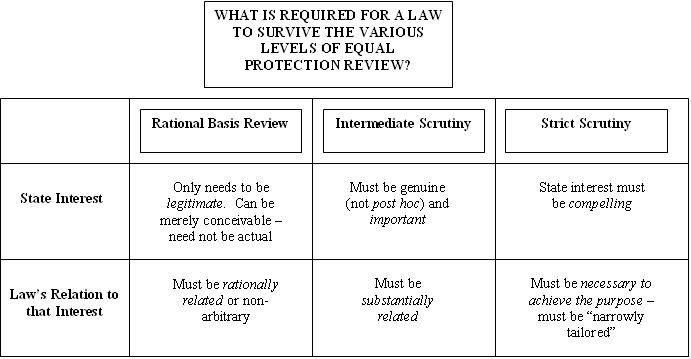

Image Retrieved from National Paralegal
Under strict scrutiny is intermediate scrutiny, for cases of gender discrimination. Under that is rational 
basis review, where discrimination cases based on sexual orientation or mental health are decided. 
I find it quite ironic that such levels exist at all. Why are different forms of discrimination created into 
a hierarchy of discrimination? Isn't this organization in and of itself discriminatory? It seems to me quite
hypocritical and unjust for someone to receive different punishments or court ruling simply because they 
are a different type of bigot than someone else.

I find these different strands inextricably linked. How deeply and strongly do we rely on rules of law, and 
for example, these seemingly hypocritical rules, when they lead to death and discrimination? Toulmin argued
 that we as a society should not mistake equality for equity, be satisfied with unjust laws, and tie our morality
unquestionably to the rule of law. "We need to recognize that a morality based entirely on general rules and
principles is tyrannical and dis-proportioned, and that only those who make equitable allowances for subtle 
individual differences have a proper feeling for the deeper demand of ethics" (p. 107 in Foss's 
Readings in Contemporary Rhetoric). I would hope that people would learn to be open-minded towards 
people's circumstances, take into account circumstances and mitigation, and let ourselves be human,
reasonable, and overcome our obsession with perfection, black/white dichotomies, and absolutism.

Sunday, September 22, 2013

Underestimating the Enemy: Creationism vs Evolution

At the beginning of August, I attended the Alta Argumentation Conference in Alta, Utah. There I was presenting a paper titled, "The Institute for Creation Research as a case study of scientific and religious argument: Revisiting argumentation fields in a postmodern context." The paper was presented on a panel of other papers about "religious argument." To summarize the points of my argument, I was discussing the ICR as an example of postmodern and contemporary creationism discourse. ICR is attempting to blur the lines between science and religion in order to present the illusion that science proves the story of Genesis.


The Logical Process of Science and Creationism: Source
My paper interrogated why creationism is still so persuasive to many people and why scientific consensus has not squashed this alternative story. In addition to this argument, I also stretched communication and argumentation theory by introducing a new term "deceptive controversy" and expanding the role of argument fields to creative normative standards. After finishing my speech and waiting for the Q&A, I thought about the theoretical implications for my argument and had prepped myself to defend my new term and the application of argument fields. Instead the first question I got was roughly paraphrased as: Aren't you giving ICR too much credit? They are obviously non-scientific, so what is the point of your paper?
To say I was shocked was an understatement. My extension of argument theory was not being questioned, but the very purpose and need for my intervention was. Unfortunately, I reacted more passionately and unprofessionally than I would have liked, feeling defensive of my research. I would like to take this blog post to react more professionally than I did then.
It is imperative that scholars and scientists take opposition from creationists seriously. Although science and logic show the truth of natural selection and evolutionary mechanics, that is unconvincing to more than half of the nation's population. The power of these narratives and the hold that biblical accounts have on the American public are underestimated at the risk of knowledge and innovation. There still remain issues of creationists gaining position on school boards, colleges accepting creationists on their staff, and the steady dominance of creationist thinking in the US.
Steady maintenance of science denial: Source
My inquiry was not to suggest that one should consider ICR scientific, but to examine how and why ICR does say that it is scientific. What is it about ICR's discourse that convinced hundreds of thousands of subscribers each month to read and examine its arguments? That was the point of my inquiry: to examine the patterns, rhetoric, and argument style that keep creationists relevant in modern society. Armed with this knowledge, how do we address and restrict its presence in areas of society it does not belong?
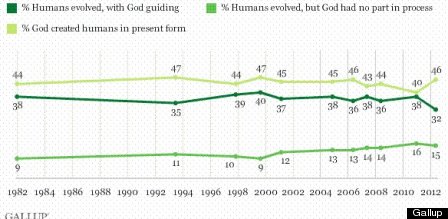
My paper took samples of ICR's discourse and broke the arguments down to their basic elements to determine if they really were scientific or not. Recent polls show only 15% of Americans believe in the occurrence of evolution without supernatural intervention, with 46% believing the in the Biblical account of origins with God (a Judeo-Christian one). That's nearly a majority of Americans who deny a scientific consensus of evolutionary mechanisms explaining origins. Groups such as ICR receive millions of dollars in charitable donations, run talking tours, sponsor museums and even a award degrees from an accredited school. Creationism discourse is alive and well in the United States, at least in the public sphere.


It is a mistake to assume that everyone approaches the creation/evolution controversy with the knowledge and capacity of intellectuals. What my questioner was really saying was that "isn't everyone in America as smart as I am? Only fools would believe in creationism." Because he saw the truth in evolution, he immediately discredited the possibility of creationism as being a valid threat. But it is. It has been and remains a threat to scientific standards, classroom education, and the knowledge of millions of Americans. To discredit their opposition is to err as many scientists have done before. To simply say "look at the science", "look at the consensus" is not enough. These facts are not convincing in the way that many academics and scholars wish that they were.


Sunday, September 15, 2013

Unified Theory of Everything: Physics and Communication

I've come across the dichotomy of physics and communication one too many times to not comment on it as a pattern. When scholars look to compare communication (as a humanities or social science) to a "hard" science, the topic usually turns to physics.

I do not know the reasons for this, but I can make basic assumptions about the two fields. Communication has humans, people, and their interactions as its focus, but physics concerns the interaction between forces, atoms, and particles that are not sentient or of free will. Although humans and particles are quite different in their motivations, actions, and behavior, the two fields actually overlap quite a bit. Both are concerned with interactions, relationship, causes and effects, and patterns. Both fields are also undergoing large arguments about the purpose of the field and how it can be united into one universal theory. For communication scholars, the journey to defining "communication" and linking disparate scholars (from cultural studies to rhetoric to psychology) in their ideology and methodology has been a task thus far daunting and unreachable.

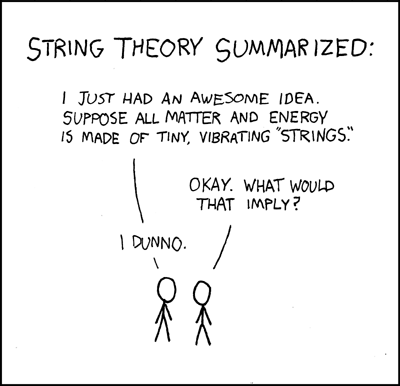
The Theory of Everything is an equally inscrutable theory of physics that links all physical phenomena under one theoretical boundary. The purpose of creating these overarching theories is not lost on me, but I fear they may never be fully realized, especially in our lifetime. The main issue that links both physics and communication in their search for the theories of everything is to find the balance between application and oversimplification. For physics, the search for the universal theory of everything is admission that some theoretical concepts do not universally apply to everything. Fundamental forces are grouped into two categories, general relativity and the three: electromagnetism, weak, and strong forces. These two groups operate under opposing principles, meaning currently, physicists are still pondering the universal forces that govern all interactions. From the rotation and orbits of planets, to the relationship between atoms and particles, there is no one solution to how forces work. The current contender for the theory of everything is "string" theory, that changes the way that matter is defined in order to negotiate the hypocrisy between weak and strong forces. Unfortunately, the theory is still being developed and is not yet being used by current researchers.
XKCD.com
In communication, there is no one theory to when, where, how, and why communication occurs. Some believe that communication is constant, some believe that only meaningful, intentional communication is important. Some believe that communication is a matter of power and oppression, where other focus on communication as persuasion, information, or networks. Introduction to Communication courses are largely a result of the professor's personal inclinations, for a class such as this could not truly begin to be an introduction to every aspect of communication, at least not as it is defined now. There are researchers currently trying to define what communication is and how all aspects of it can be linked with one unified theory with the purpose of creating unified though, research, and meaning out of the field.

I am skeptical that such unified theories will ever truly exist, at least not in ways that everyone can agree on. For what purpose is a communication theory that discounts racial, ethnic, or gender differences? How applicable can a theory be that does not acknowledge the impact of technology, networks, and relationships among people? There are so many different aspects of communication, that to create a unified theory must privilege some and reject others. Reducing the varied, exciting, and unique field of communication to one theory would undermine the ability of researchers to address specific problems, artifacts, and inquiries with the most appropriate theoretical tool. The theory of everything for physics would mainly help simplify physical formulas and streamline research and data, but little would change for most researchers. Simply because, current theories function well to predict small interactions, and general relativity functions well to predict large interactions. Combining them would change very little about these predictions, except for that they would be linked. The one exception would be for those objects that are both tiny and massive; namely, black holes complicate this separation. Black holes are massive, but occupy very little space, so theoretically, both sets of theories should apply, and yet, they cannot.
I applaud scholars whose research finds them looking to larger, theoretical problems. I believe that most researchers, though, might find their time better spent analyzing and solving smaller, more meaningful communication and physics issues.

Smbc-comics.com