Sunday, September 15, 2013

Unified Theory of Everything: Physics and Communication

I've come across the dichotomy of physics and communication one too many times to not comment on it as a pattern. When scholars look to compare communication (as a humanities or social science) to a "hard" science, the topic usually turns to physics.

I do not know the reasons for this, but I can make basic assumptions about the two fields. Communication has humans, people, and their interactions as its focus, but physics concerns the interaction between forces, atoms, and particles that are not sentient or of free will. Although humans and particles are quite different in their motivations, actions, and behavior, the two fields actually overlap quite a bit. Both are concerned with interactions, relationship, causes and effects, and patterns. Both fields are also undergoing large arguments about the purpose of the field and how it can be united into one universal theory. For communication scholars, the journey to defining "communication" and linking disparate scholars (from cultural studies to rhetoric to psychology) in their ideology and methodology has been a task thus far daunting and unreachable.

The Theory of Everything is an equally inscrutable theory of physics that links all physical phenomena under one theoretical boundary. The purpose of creating these overarching theories is not lost on me, but I fear they may never be fully realized, especially in our lifetime. The main issue that links both physics and communication in their search for the theories of everything is to find the balance between application and oversimplification. For physics, the search for the universal theory of everything is admission that some theoretical concepts do not universally apply to everything. Fundamental forces are grouped into two categories, general relativity and the three: electromagnetism, weak, and strong forces. These two groups operate under opposing principles, meaning currently, physicists are still pondering the universal forces that govern all interactions. From the rotation and orbits of planets, to the relationship between atoms and particles, there is no one solution to how forces work. The current contender for the theory of everything is "string" theory, that changes the way that matter is defined in order to negotiate the hypocrisy between weak and strong forces. Unfortunately, the theory is still being developed and is not yet being used by current researchers.
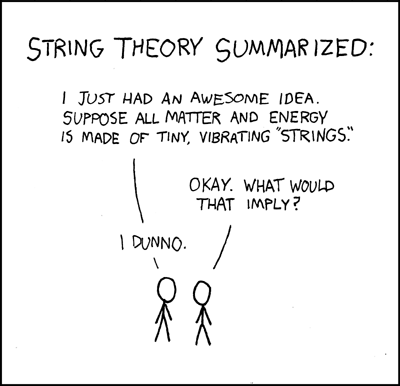
XKCD.com
In communication, there is no one theory to when, where, how, and why communication occurs. Some believe that communication is constant, some believe that only meaningful, intentional communication is important. Some believe that communication is a matter of power and oppression, where other focus on communication as persuasion, information, or networks. Introduction to Communication courses are largely a result of the professor's personal inclinations, for a class such as this could not truly begin to be an introduction to every aspect of communication, at least not as it is defined now. There are researchers currently trying to define what communication is and how all aspects of it can be linked with one unified theory with the purpose of creating unified though, research, and meaning out of the field.

I am skeptical that such unified theories will ever truly exist, at least not in ways that everyone can agree on. For what purpose is a communication theory that discounts racial, ethnic, or gender differences? How applicable can a theory be that does not acknowledge the impact of technology, networks, and relationships among people? There are so many different aspects of communication, that to create a unified theory must privilege some and reject others. Reducing the varied, exciting, and unique field of communication to one theory would undermine the ability of researchers to address specific problems, artifacts, and inquiries with the most appropriate theoretical tool. The theory of everything for physics would mainly help simplify physical formulas and streamline research and data, but little would change for most researchers. Simply because, current theories function well to predict small interactions, and general relativity functions well to predict large interactions. Combining them would change very little about these predictions, except for that they would be linked. The one exception would be for those objects that are both tiny and massive; namely, black holes complicate this separation. Black holes are massive, but occupy very little space, so theoretically, both sets of theories should apply, and yet, they cannot.
I applaud scholars whose research finds them looking to larger, theoretical problems. I believe that most researchers, though, might find their time better spent analyzing and solving smaller, more meaningful communication and physics issues.

Smbc-comics.com

Monday, September 9, 2013

Words to Reconsider

I'd previously wanted to title this: Words you shouldn't say anymore, but I changed the title to reflect how my opinions aren't those of everyone. Prescribing language changes for all people, though I believe that these are respectful and accurate changes, is problematic for many reasons. These suggestions are more for people who are already in line with my beliefs, namely liberal ones, and how to adjust your language choices to be more respectful of others and values.

Racial slurs: First of all, my previous post on Django referenced this briefly, but racial slurs are not appropriate in every day use. This primarily applies to the non-African American, black, brown, or identifying groups that may use racial slurs in jest, for shock value, or as a political statement. They are not words that most of us should or can say, by re-appropriating them into white vernacular, they lose their political meaning and importance. Simply put, these words can be used to reinforce power hierarchies and should not be used lightly or at all by dominant groups.


Tarantino Responding to Criticism about Django

Pro-life: This term has bothered me for a long time. What exactly is pro-life about banning women from having abortions? Abortions can be a life-saving procedure and refusing one can lead to complications and death. The idea that a fetus is alive is based on religious definitions that life begins at conception. For non-believers or those that operate under a different definition of when life begins, the life of the mother is the life that needs to be protected. The life of the mother is not always immediately in physical danger, as was Savita Halappanavar's, but there is always emotional and psychological life to worry about. Although many pregnancies are intentional, women do become pregnant for many reasons accidental or through force. Denying these women the right to closure and healing from rape, incest, or other emotional traumas can be damaging to a woman's life as well. Instead of "pro-life" which I have described as very misleading, I endorse the term "anti-choice" to emphasize the true issue: deciding for women what they wish to do with their bodies. If life were really the issue, then the woman's life would weigh importance as well, which for many anti-choice groups, though not all, it is of secondary importance, if that. Perhaps the most disturbing part of the anti-choice movement is that by equating the fetus with a child, they respond to abortion clinics and places like Planned Parenthood as if they were attacking murderers. Abortion practitioners have been threatened and killed (pro-life, huh?) and funding for PP has been cut in many states.

Savita Halappanavar
English in general: I recently read an amazing chapter from bell hooks who discussed the emphasis on clean, pure English as a means of stripping people (primarily former slaves and their descendants) from keeping in touch with their roots through dialect. She quoted a poem by Adrienne Rich saying, "this is the language of my oppressor, but I need it to talk to you". This statement is powerful and I feel needs no explanation or extrapolation except to say that the hegemony of the English language is not something always laudable. We should all try to learn other languages and encourage others (as bell hooks describes in a teaching role) whether they be friends, family, or students to speak how they feel comfortable speaking and encourage expression in multiple voices.

Source

Boy/girlfriend, wife/husband: I think that these words should be replaced with the gender neutral counterparts of "significant other", "partner", "spouse", etc. Assigning and using these terms reinforces heteronormative definitions of marriage that use the binary gender terms, male and female, as the standard. Despite setbacks, such as Proposition 8, marriage is on its way to being redefined as open to homosexual couples. To reflect this openness and one's agreement with the changes, more gender neutral terms should be used to describe couples. Some homosexual couples may prefer the girl/girl friend or boy/boy friend terms, and that should be respected. For general conversation, however, the gender neutral terms are more encompassing and respectful. This gender neutrality follows for trans* and members of the queer community. Pronoun and name usage is something that I am still struggling with, but I find that simply asking for one's preferred gender pronoun is the best option. For some, their outward appearance may not reflect where they are on their personal journey of identification and which gender pronoun they would prefer. One's sexual organs does not adequately describe most people's gender identities and can be restricting in terms of expression. I remember hearing a quotation from a friend at an LGBTQ event at Northeastern: "I wish I had been born a girl, instead of just having this vagina." This statement highlights the struggle of many people attempting to realign their physical gender with one's felt gender and how sexual organs should be not be defining characteristic of a human being.

These are a few suggestions for different word choices that I think might be helpful for more open, liberal-minded people. For people who are anti-choice, pro-heteronormativity, and perhaps unconcerned with issues of race, these suggestions may fall on deaf ears. For others, I hope that these at least spark some thinking about the power of the words that we use, what context we use them, and who we use them with in defying hierarchies and promoting equality.

Tuesday, September 3, 2013

Cyborgs: Entertainment and Reality

Many great scholars before me and currently have performed more extensive inquiries into the nature of cyborgs and the growing intersection of humankind with technology. My interest has been piqued in this topic tangentially, as I have interests in the use of technology for information gathering, dissemination, validation, and power. Inf/using technology in our daily lives is simply an inevitability that communication scholars must address, and cyborgs are an interesting "end product" in my mind. The cyborg represents a unity between humans and technology, faults and flaws permanently mended by technological advancements and prowess.

Because the cyborg, for the most part, only exists in fiction, much of the cyborg's mythology comes from media representations. The relationship between humans and technology range from fully robotic operation with human appearance (e.g., The Stepford Wives) to humans with technological modifications (e.g., Planet Terror) with traditional definitions of "cyborgs" operating near the halfway point (e.g., the Six Million Dollar Man). They key appears to be integration, where a character has equal or mostly equal human and technological parts that operate as parts of a unified whole. Someone using a gun (i.e., picking it up and using it) is quite different from having one functioning as a leg and being able to fire it from internal signals instead of pulling the trigger.


After some pondering (and heated discussion with my significant other) about the nature of cyborgs, we also reached a conclusion that cyborgs are not merely people with technological parts (e.g., a person with a pacemaker), but this technological addition must perform a fundamentally inhuman task. Iron Man, though he has a metallic plate protecting his heart, the addition of this technology does not provide him inhuman strength, power, or wit (that's just Robert Downey Jr.). Will Smith, however, in I-Robot, does have robotic additions that give him extra strength and powers, like the superhero that Iron Man is. Instead of a suit that can be taken on and off, true cyborgs have integrated technology with their human bodies to advance the form beyond what was previously possible.

The thinking about cyborgs began with my viewing of The Amazing Spiderman, where the antagonist has lost a limb and pines for its re-growth and repair. Whereas he believes the solution lies in cross-species DNA, the attempt to achieve this ends spectacularly well, a la The Fly. When I think of his pining over perfection, and yet the inability to consider a prosthetic arm, it echoes my feelings above that the functionality of the cyborg is the key. A prosthetic arm would perform basic functionality of an arm, but to replicate it perfectly and to extend its strength, a robotic replacement would be needed. What Dr. Collins realizes is that in his search for perfection, he must replace the entirety of the human body, for it is weak and vulnerable. In his transition to a lizard-human hybrid, he becomes similar to a cyborg in that his human form has been replaced with stronger and more powerful parts to complement the human form.


A live example of the cyborg may be found in Neil Harbisson, a color blind person who used a prosthetic eye piece to hear colors. Though he sees colors in shades of grey, the eye piece translates each types of color, including its shade and vibrancy, into sounds that he can understand. He is attempting to have the eye piece surgically attached to his spine, fully integrating the eye piece to his human form. There's no need for me to define him as a cyborg, he's done that already.


The Cyborg Foundation that he founded is the first organization working to defend cyborg rights and indeed encourages people to embrace technological additions. One of their listed aims is "to extend human senses and abilities by creating and applying cybernetic extensions to the body" and they describe their missions statement as "helping people to become cyborgs." This is quite a radical step in theory but these changes are already beginning. Consider the Futurama episode "Eye-Phone" that made fun of the attachment that people have to their technology by implanting one's phone behind the eye socket. Now, Google Glass is in its "explorer" mode and may soon become a normalized part of our technological experience.


Photo source
In the future, cyborgs may become the new human rights campaign. Whereas in the past, people have been dehumanized based on the color of their skin, their choice of religion, and their sexuality and partner preferences, the future may hold civil rights battles on behalf of cyborgs and their definition as more than/human. If the past battles were about defining humanity in terms of property, voting, and marriage, then future definitions of humanity will surely be tested.